


News Center
How to Choose a Screen Stretching Machine: A Practical Buyer's Checklist
 2026-11-04
 107
A screen stretching machine (also called a screen mesh stretcher or tensioning unit) decides how flat, how even, and how repeatable your screens are before they ever hit the press. Buy the wrong one and you inherit ghosting, uneven print deposit, mesh slippage, and frames that have to be re-tensioned every other run.
This guide walks through the specs and trade-offs that actually matter — written for production managers and process engineers who are short on time.
1、Match the tension range to your mesh and application
Not every mesh needs the same pull force. Low-tension textiles and glass printing often run comfortably in the 15–35 N/cm range, while solar PV, PCB, and precision LCD touch-screen work demand tighter, more consistent tension — typically up to 50–60 N/cm and zero slip.
Before you ask for a quote, confirm:
The mesh types you run (polyester, nylon, or stainless steel).
The target tension in Newton per centimeter (N/cm), not "tight."
Whether the machine can hold that tension without the mesh sliding in the clamps.
A machine that only claims "high tension" on the brochure but slips under 0–60 N will fail on high-precision jobs.
2、Demand uniform tension across the whole frame
The single biggest source of print defects is tension that is even on paper but uneven in practice — corners tighter than the middle, or one side pulled harder than the other.
Look for:
Independent, synchronized clamping along all sides so force is applied in parallel, not corner-by-corner.
Precision 2.5-D / tension verification that calculates the optimal pull distance based on cylinder pressure and mesh friction, rather than relying on operator feel.
Even-force locking so the mesh does not relax or dislocation-deform after the lock-down.
If a supplier cannot explain how tension is verified, treat that as a red flag.
3、Check the maximum frame size — and your future footprint
Machine naming usually hides the working area. For example, the SUBIT LY2555 is built for large-format integral tensioning suited to big-panel work. Measure your largest frame, then add margin — you will almost certainly run larger screens next year than you plan for today.
Also confirm:
Maximum and minimum frame dimensions.
Whether the table accommodates both wood and aluminum frames.
Floor footprint, since automatic units are larger than manual handheld stretchers.
4、Automatic vs. manual: pick by volume, not by budget
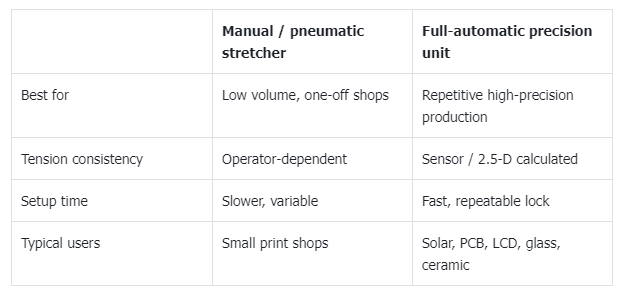
If your customer base is quality-sensitive (electronics, PV, medical), the automatic unit pays for itself in rejected screens saved.
5、What the clamp and lock system decides
The lock net has to be convenient, quick, and force-even — that is what makes the screen accurate. Cheap clamps creep under sustained pressure, which means a screen that measured 25 N/cm on day one reads 18 by day ten.
Ask the manufacturer directly:
What is the clamp construction (alloy / hardened, grip surface)?
How is the mesh locked — mechanical, pneumatic, or hydraulic?
What is the tension hold-over time / relaxation behavior?
6、Application-specific questions
Different industries stress the machine differently:
Solar / photovoltaic — needs ultra-uniform tension for fine-line conductive paste.
PCB / circuit board — registration accuracy and zero mesh slippage are non-negotiable.
LCD touch screen / glass printing — flatness and dislocation-free deformation.
Ceramic & textile printing — larger mesh types, including stainless steel mesh.
Tell your supplier the exact industry and typical line speed; a good manufacturer will recommend the right tension ceiling rather than selling you the biggest unit.
7、After-sales and local support matter more than you think
A stretching machine runs for 8–15 years. Prioritize suppliers who:
Provide installation, training, and remote troubleshooting.
Ship spare parts (seals, clamp pads, pressure valves) reliably.
Will customize clamping or frame dimensions for your shop.
8、Questions to ask before you request a quote
Send these to any shortlisted manufacturer — the quality of the answers tells you more than the catalog:
What is the real, verified tension range (N/cm), and how is it measured?
How do you guarantee no slip, no gap, and no dislocation deformation?
What frame sizes and mesh types (polyester / nylon / stainless) does this model support?
Do you use 2.5-D detection to calculate the optimal pull distance?
What is the lead time, warranty, and spare-parts policy?
Get a specification matched to your job
At SUBIT, we manufacture screen stretching equipment in Shenzhen, China — including the full-automatic, precision integral LY2555, engineered for 0–60 N tension with even-force locking and 2.5-D tension calculation for solar, PCB, LCD, glass, and ceramic printing.
Tell us your mesh type, target tension, and largest frame size, and we will send a tailored configuration and quote — not a generic catalog.
Previous: How to Choose the Right Stencil Inspection Machine for Your SMT Line (2026 Buyer's Guide) Next: no more


