



News Center
How to Choose the Right Screen Printing Squeegee Glue Grinding Machine for Your Shop
 2026-11-04
 103
A dull, nicked, or uneven squeegee edge is one of the most underestimated causes of bad prints. Edges feather, ink deposit varies run to run, and you burn through more squeegee blades than you should.
A proper squeegee glue grinding machine (also called a squeegee grinder, sharpener, or regrinder) restores that edge close to factory condition in minutes. But a poorly chosen grinder does more harm than good — it flexes the rubber during the cut, leaves a wavy edge, and locks you into one geometry you didn't pick.
We build these machines at Subit (Shenzhen), so below is the checklist we actually walk print-shop owners through when they ask, "What should I really be looking at?"
1、Judge the edge first — price second
The entire purpose of grinding is a flat, ripple-free edge at the exact bevel angle you need. When you evaluate a machine, ask the supplier:
Does it use a diamond grinding wheel? Diamond wheels cut rubber cleanly and last dramatically longer than aluminum oxide wheels, which glaze over and heat the blade.
Is the grinding pressure controlled? A pressure-free abrasive design keeps the rubber from flexing mid-cut. That flex is exactly what creates the wavy, "strong-line" edge you'll see on low-end sharpeners.
Can I verify flatness? Ask for a test grind and run a straight edge across the blade afterwards. If it isn't flat, nothing else on the spec sheet matters.
2、Angle range matters more than shops think
Different jobs demand different squeegee geometries:
General graphics, decals, and textiles usually run a 65–75° bevel.
Thick/textile inks, puff, and specialty effects often need a shallower or steeper bevel to lay down ink correctly.
Look for a machine that adjusts across roughly 0–45°, so you aren't trapped in one setting. Also confirm the wheel speed stays stable under load — if it bogs down, your finish quality drops with it.
3、Compatibility with your existing squeegees
Most shops run a mix of domestic and imported squeegee brands, and often a mix of:
Mechanical / holder-mounted squeegees, and
Manual (hand-held) blades.
Confirm the grinder handles both before you buy. Shops that buy a single-purpose model frequently discover they're still hand-grinding half their stock.
4、How the blade is held during grinding
A card-lock (quick-clamp) design lets you secure and adjust the deformed scraper blade during the grind. If the rubber shifts even slightly mid-cut, you lose the edge you were trying to create.
Two related maintenance points worth checking:
Is the grinding wheel easy to install and disassemble? Wheel changes should be a 5-minute job, not a service call.
Is the working area large enough for your longest squeegee? Wrestling a 1.5 m blade around a tiny bed slows down daily use.
5、Don't skip dust extraction
Squeegee rubber dust is something staff shouldn't breathe, and most regulators (OSHA in the U.S., equivalent bodies in the EU and UK) expect dust control. A machine with a built-in vacuum unit reduces airborne rubber dust, keeps the grinding area visible, and protects the wheel bearings.
If a model doesn't offer one built in, add the cost of a separate extractor and ducting into your comparison — it's rarely free.
6、If your staff can't learn it in a shift, you won't use it
Shop-friendly machines share these traits:
No specialized technician required for daily operation.
Simple, accessible controls.
Routine maintenance points are easy to reach.
Reasonable working area and a straightforward setup.
A grinder that intimidates people ends up parked in the corner. The most expensive machine in the world is worthless if nobody runs it.
Red flags to walk away from
No pressure control on the grinding wheel
Fixed angle (no bevel adjustment)
No dust extraction option
Wheel changes that require a technician
A working bed too small for your longest squeegee
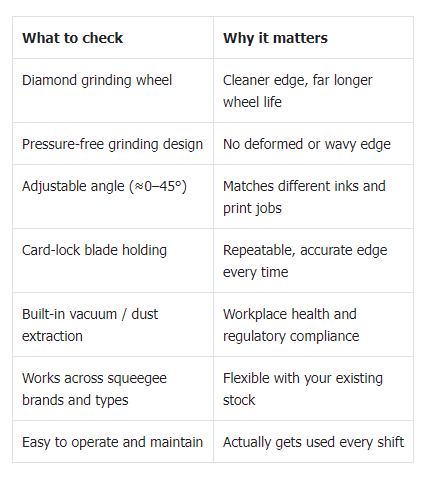
Quick comparison checklist
Final thought
The right squeegee grinder pays for itself in saved blades, fewer rejected prints, and more consistent ink deposit — but only if it grinds flat, holds the angle, and your team is willing to run it daily.
At Subit, we manufacture squeegee glue grinding machines built around exactly these points: a diamond grinding wheel, pressure-free grinding design, 0–45° angle adjustment, card-lock blade holding, and an integrated vacuum unit. They're in daily use by shops running both domestic and imported squeegee brands.
If you're comparing models and want a spec sheet, a test-grind video, or a quote sized to your shop volume, reach out to our team. We'll tell you honestly whether our machine fits your workload — and if it doesn't, we'll tell you that too.
Previous: Laboratory Powder Mixing Machine: A Practical Buyer's Guide for R&D Labs Next: How to Choose the Right Stencil Inspection Machine for Your SMT Line (2026 Buyer's Guide)


