


News Center
How to Control EOM with an Auto Precision Emulsion Coating Machine: A Practical Guide
 2026-10-09
 106
106
If you have ever pulled a screen off press and noticed inconsistent ink deposit, pinholes, or premature stencil breakdown, the root cause often traces back to one number: EOM (Emulsion Over Mesh) . For screen printing shops, mastering EOM is not optional—it is the foundation of every sharp print, every durable stencil, and every repeatable job.
This guide covers the practical steps for controlling EOM using an automatic precision coating machine, and explains what to look for when investing in equipment that delivers consistent results at scale.
What Is EOM and Why Should You Care?
EOM measures the emulsion thickness on the substrate side of the mesh as a percentage of mesh thickness. Industry manufacturers recommend an EOM ratio of 10 to 20 percent. If the emulsion layer is too thin, you will struggle to form a proper gasket seal with the substrate, leading to saw-tooth edges and poor detail resolution. If it is too thick, ink transfer becomes difficult, and details can break down during a run.
For water-based and discharge printing, EOM is especially critical for stencil durability—if your exposure calibration was done on a screen with 8% EOM but you actually coat to 20%, the stencil will not survive the run.
Key Variables That Control EOM
When using an automatic coating machine, three primary parameters determine your final EOM:
1. Coating Speed. This is the most direct lever. Slower coating speeds allow the emulsion to flow through the mesh more completely, increasing EOM. Faster speeds deposit less emulsion and reduce EOM. Automatic coaters are designed to coat slowly to prevent air bubbles from forming behind mesh knuckles—something manual coaters often fail to achieve when rushing.
2. Coating Pressure. Higher pressure pushes more emulsion through the mesh, which can increase EOM on the print side. However, excessive pressure with too many strokes can paradoxically result in near-zero EOM because the emulsion is scraped away rather than deposited. The key is balancing pressure with speed.
3. Number of Coating Cycles. Different mesh counts require different coating recipes. A 305 mesh may work well with a 1:2 coat (one pass on the squeegee side, two on the print side), while a lower mesh count like 60 may need slower coating speeds and a 2:3 coat using the dull edge of the coater.
Most shops need only three to four coating recipes for textiles, and one or two for UV graphic applications where mesh counts are typically in the 300–380 range.
Why Manual Coating Fails at EOM Control
Manual coating introduces too many variables: operator speed, angle, pressure, and trough emulsion level all affect the result. When rushed, hand coaters whip air into the emulsion with fast coating speeds, and EOM can vary by as much as 20% from screen to screen. That variance directly translates to inconsistent exposure times and unpredictable stencil quality.
Automatic coaters solve this by being predictable—set them up correctly, and they will apply emulsion the same way every time, regardless of who operates them.
What to Look for in an Automatic Precision Coating Machine
When evaluating equipment for EOM control, focus on these specifications:
Stepless speed control for fine-tuning emulsion deposit without discrete speed steps
Linear motion guidance to eliminate vibration that causes uneven coating
Programmable coating cycles (typically 1–10 passes per side) for different mesh recipes
Compatible frame thickness range to handle your production mix
Heavy-duty construction for stability during continuous operation
The Subit SBT-TP1215 Auto Precision Emulsion Coating Machine, manufactured by Shenzhen Subit, is engineered specifically for high-precision screen plate-making. It addresses the three most common industry pain points: uneven emulsion thickness, inconsistent coating repeatability, and low production efficiency.
Verified Technical Specifications:
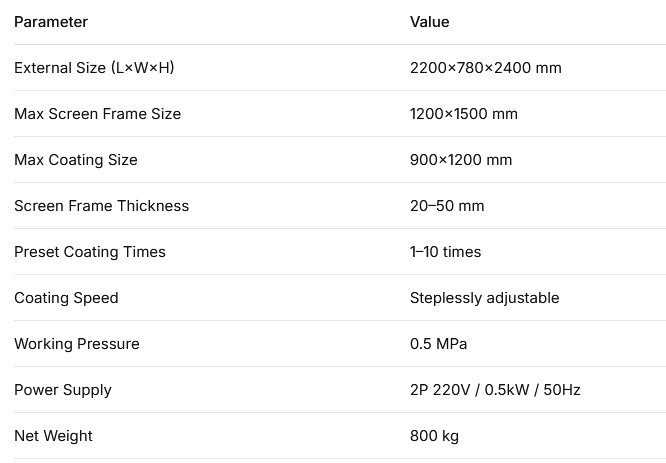
The machine uses a programmable controller paired with an inverter controller for precise parameter setting and speed regulation. Its walking linear guide and linear bearings ensure backlash-free coating travel, while the 800kg rigid structure maintains low vibration even during continuous operation—extending service life and reducing maintenance costs.
For shops handling frames from 20mm to 50mm in thickness, the SBT-TP1215 covers most standard screen printing plate-making demands. The integrated photoelectric safety switches and low-voltage control circuits protect operators during daily use.
Building Your EOM Recipe
Once your automatic coater is in place, follow this process to dial in your EOM:
Start with a test screen. Measure your target EOM using a thickness gauge before committing to production runs.
Set a baseline recipe. For a 305 mesh with sharp-edge coater, try 1:2 coating. For lower mesh counts, increase passes and slow the coating speed.
Measure and adjust. If EOM is too low, reduce coating speed first, then increase pressure. If too high, increase speed or reduce coating passes.
Document and repeat. Save each recipe in the machine's programmable memory for instant recall.
Get a Tailored Solution
Controlling EOM is a production discipline, not a one-time setup. The right automatic coating machine turns that discipline into a repeatable, operator-independent process.
As a Shenzhen-based manufacturer specializing in screen printing equipment, Subit provides custom configurations, sample testing support, and full after-sales service. For a detailed quotation, custom parameter adjustment, or technical consultation, contact our sales team today—we will respond with a professional, tailored solution within 24 working hours.
Previous: Manual vs Pneumatic vs Electric Screen Stretching Machine: Which One Fits Your Production Line? Next: no more


