

News Center
Manual vs Pneumatic vs Electric Screen Stretching Machine: Which One Fits Your Production Line?
 2026-10-09
 105
105
The hidden cost of the wrong stretching machine
If your production line struggles with inconsistent tension, frequent mesh breakage, or high scrap rates on precision work, the bottleneck may not be your press or your operators — it is likely your stretching machine. Research links up to 30% of print defects directly to uneven screen stretching
For PCB, solar, and LCD touchscreen production, a tension deviation of just 1–2N can render an entire batch unusable
This guide breaks down the three main types of screen stretching machines so you can choose the right one for your production line.
How the Three Types Differ
Manual stretching machines use hand cranks or levers to pull the mesh. They are cost-effective and require no power supply, making them suitable for small-scale or occasional operations. However, tension accuracy is limited — typically around ±1N/cm — and the operator must manually adjust all four sides, which makes consistent results nearly impossible to replicate
Pneumatic stretching machines use air pressure to apply tension through pneumatic clamps. They offer faster operation than manual machines and better consistency, making them a solid choice for medium-volume print shops. Pneumatic systems typically achieve tension accuracy of around ±0.5N and can be operated in automatic or manual mode. However, they still depend on external air supply and electro-pneumatic pressure converters for independent axis control, which adds system complexity and can create response lag in dynamic tension adjustments.
Electric (servo-driven) stretching machines use servo motors with precision screw transmission to apply and monitor tension in real time. This is the only category that delivers closed-loop tension control with micron-level data display. The Subit LY2555, for example, achieves ±0.5N tension accuracy across a maximum stretching area of 2500×5500mm, with a 0–60N adjustable range covering polyester, nylon, and stainless steel mesh.
Key Decision Factors
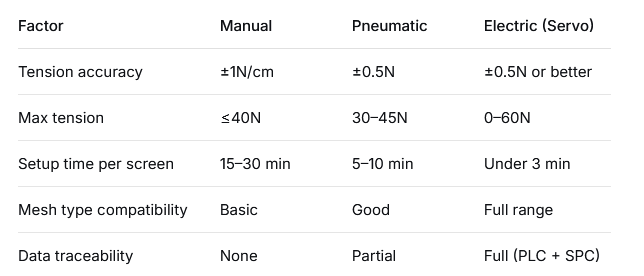
Electric systems go beyond simple force application. Advanced models like the LY2555 use 2.5-D precision detection to calculate the optimal force distribution between cylinder pressure and mesh traction friction, ensuring uniform tension even at the corners where most breakage occurs. The machine's Bridge-type tension balancing system automatically buffers force at all four corners during stretching, preventing mesh explosion at maximum tension.
The automation gap is also significant. With servo and PLC control, a single screen tensioning operation can be completed in under 3 minutes, far exceeding the efficiency of manual adjustment and eliminating the consistency differences caused by operator skill variation.
Which One Fits Your Production Line?
Choose manual if: You run a small shop with low-volume, non-critical textile printing and your budget is the primary constraint. Expect to trade off consistency and throughput.
Choose pneumatic if: You need a middle-ground solution for medium-volume production with reasonable precision requirements, and your facility already has a reliable compressed air supply.
Choose electric if: Your production involves PCB, solar photovoltaic, LCD touchscreen, glass printing, or ceramic decoration — anywhere that requires high-tension, high-precision mesh stretching with repeatable results. The LY2555 is designed for maximum 2500×5500mm and minimum 1500×5500mm formats, with a 5kW total power draw on a standard 3AC/380V/50Hz supply.
For operations running multiple mesh types and screen sizes, the PLC intelligent control system stores tension parameters for different materials and formats, cutting setup time and removing dependence on individual operator experience. Combined with a high-strength steel body and automotive-grade tapered drive components, this class of machine is built for continuous industrial operation.
The Bottom Line
The right stretching machine is not just a tool — it is a quality control system. Manual and pneumatic machines have their place, but when your production line demands micron-level accuracy and batch-to-batch consistency, an electric servo-driven system is the only answer that scales.
At Subit, we have been manufacturing precision screen stretching equipment from Shenzhen for over 12 years, serving industrial printers in more than 40 countries. Our LY2555 is engineered specifically for high-tension, large-format production in electronics, solar, and display manufacturing.
Still unsure which type fits your line? Send us your mesh type, screen size, and daily output volume — our engineers will recommend the right configuration for your specific process. [Contact Subit for a free consultation →]
Previous: How to Choose a Fully Automatic Screen Exposure Machine for High-Yield PCB & Printing Next: How to Control EOM with an Auto Precision Emulsion Coating Machine: A Practical Guide


