


News Center
Screen Stretching Machine in 2026: Is Your Shop Ready for the Next Wave?
 2026-08-28
 187
187
The screen printing industry is evolving faster than ever — and if your screen prep workflow hasn’t kept up, you’re leaving money on the table.
The global screen printing market is valued at US$11.6 billion in 2026** and is projected to reach **US$15.3 billion by 2034. But here’s the catch: the market isn’t growing the way it used to. Orders are shorter, customers demand more customization, and automation is no longer optional — it’s the new standard.
In this article, we’ll break down what’s actually happening in screen printing right now, why mesh tension matters more than ever, and how the right screen stretching machine can future-proof your shop.
What’s Actually Changing in Screen Printing
If you’ve been in the game for a while, you’ve noticed the shift. It’s not that screen printing is going away — far from it. The global automatic apparel screen printing equipment market alone grew to $239 million in 2025** and is expected to hit **$344 million by 2032.
But the nature of the work has changed:
1. Orders are getting shorter. High-volume runs still exist, but they’re no longer the default. Nearly 6 billion annual screen printing impressions now fall into run lengths below 1,000 units. Flexibility is now just as valuable as raw speed.
2. Automation is becoming table stakes. Automated exposure units, screen handling systems, and workflow software are reducing manual steps — helping shops rely less on skilled labor while delivering more consistent results. IoT-enabled platforms with real-time monitoring and predictive maintenance are becoming standard requirements, with software now accounting for 15–20% of total machine cost.
3. Hybrid production is the new normal. DTF and screen printing aren’t competing — they’re collaborating. Many printers now start with digital methods and realize screen printing offers quality, longevity, and credibility that customers value. The most successful shops use both.
4. Sustainability is non-negotiable. Cleaner ink systems, reduced water usage, and improved waste handling are now core business requirements.
So what does all this mean for your screen stretching operation? Simple: inconsistent screens don’t just hurt quality — they kill agility.
Why Mesh Tension Is the Foundation of Everything
You can have the best automatic press, the finest inks, and the most skilled operators. But if your mesh tension is off, none of it matters.
Mesh tension is measured in Newtons per centimeter (N/cm) . Think of tight mesh like a trampoline — it rebounds cleanly and predictably. Loose mesh behaves like a sagging hammock that absorbs energy, distorts, and leaves you fighting for control.
Here’s what low tension actually costs you:
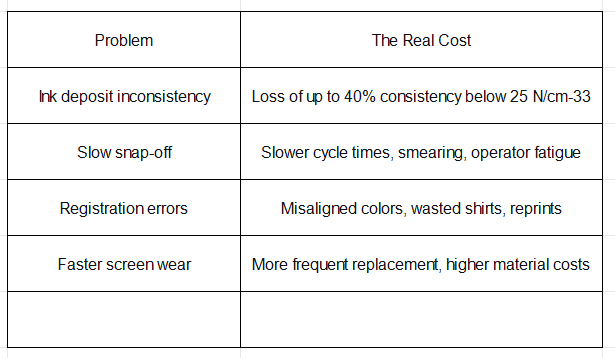
For most textile applications, screens should read between 25–35 N/cm. Halftone and process color work often require 30–40 N/cm. Under 20 N/cm, a high-mesh screen is really only good for single-color work — and even then, you’re pushing your luck.
The kicker? Every time you pull a squeegee or reclaim a screen, you drop a little bit of tension. Without a proper stretching process and regular tension checks, your screens degrade silently — and your print quality goes with them.
What to Look for in a Screen Stretching Machine in 2026
Not all stretching machines are created equal. Here’s what matters most:
1. Tension Accuracy and Control
Look for ±0.5 N/cm accuracy or better. Your machine should support incremental tensioning — stretching in stages (e.g., 15N → wait → 20N → wait → target) allows mesh fibers to relax between pulls, resulting in more stable final tension.
2. Maximum Tension Capability
Professional machines should reach at least 50 N/cm, with some applications requiring up to 60 N/cm. Higher isn’t always better — but having headroom means you’re never under-equipped.
3. Frame Size Compatibility
Your machine should handle your minimum and maximum screen sizes. Quality equipment typically offers a wide range of adaptability.
4. Build Quality and Durability
High-strength steel construction and automotive-grade components aren’t marketing fluff — they determine whether your machine delivers consistent results for years or starts drifting after months.
5. Ease of Operation and Maintenance
With shorter runs and faster changeovers becoming the norm, you can’t afford equipment that’s a pain to set up and maintain.
SUBIT: Precision Engineering for the Demands of 2026
As a specialized manufacturer since 2014, SUBIT Technology has been designing screen stretching machines that meet the evolving needs of modern print shops — from textile and garment printing to solar photovoltaic, circuit board, LCD touch screen, and glass printing applications.
What sets SUBIT apart:
PLC microcomputer control with intelligent HMI for accurate, stable operation
Tension accuracy of ±0.5 N — industry-leading precision for repeatable results
Maximum tension up to 60 N — handling everything from polyester to stainless steel mesh
Maximum stretching area up to 1500×3500mm, with customization available
High-strength steel construction and automotive-grade drive components for long-term reliability
Rotary lock cylinder automatic self-locking for even force distribution and slip-free netting
Whether you’re running a growing print shop that needs a pneumatic stretcher or an industrial-scale operation requiring a fully automatic system, SUBIT delivers the precision and durability that professional printers rely on.
Final Thoughts: The Bottom Line
Screen printing isn’t going anywhere. The global market is growing — but it’s growing differently. Shorter runs, more customization, and higher quality expectations mean your screen prep process has to be faster, more consistent, and more reliable than ever.
Mesh tension isn’t a detail. It’s the foundation. Get it right, and everything else — print quality, production speed, profitability — falls into place. Get it wrong, and you’re fighting an uphill battle with every print.
Ready to upgrade your screen stretching for 2026 and beyond? Contact SUBIT Technology today to find the right solution for your production needs.
Previous: LED Energy Saving Screen Exposure Machine: The Smart Choice for High-Precision Manufacturing Next: Semi Auto Stencil Printing Squeegee Blade Inspection Machine – Improve SMT Yield with SUBIT


