

News Center
LED Energy Saving Screen Exposure Machine: The Smart Choice for High-Precision Manufacturing
 2026-08-28
 198
198
Why Switch to LED Exposure Technology?
If you’re still using traditional mercury lamp exposure machines for screen printing or PCB manufacturing, you’re likely dealing with high energy bills, frequent lamp replacements, heat damage to substrates, and inconsistent exposure quality. The industry is shifting—and for good reason.
LED exposure technology isn’t just an incremental improvement; it’s a fundamental upgrade that directly impacts your bottom line, product quality, and environmental compliance.
The Hard Numbers: LED vs. Mercury Lamp
Let’s cut through the marketing and look at real performance data:
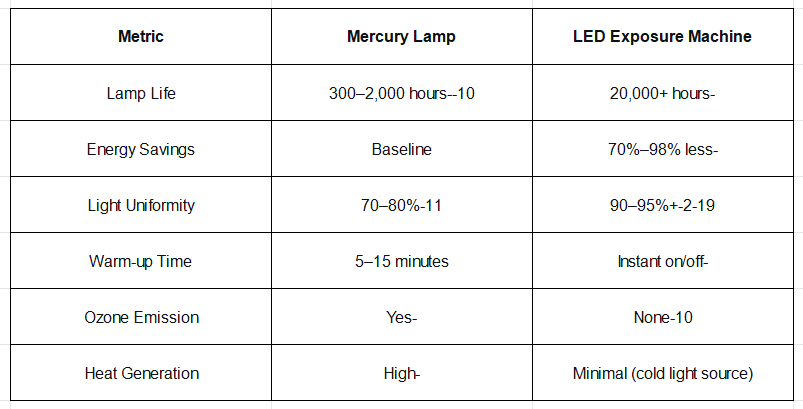
A mercury lamp degrades from the very first use, while LED systems maintain consistent output for over 20,000 hours. That means fewer production stoppages, less waste, and consistent quality batch after batch.
4 Key Benefits That Actually Matter
1. Massive Energy Savings
Traditional mercury lamp exposure machines consume enormous amounts of electricity—not just for the lamp itself, but for the cooling systems required to manage the intense heat. LED exposure units consume roughly 1KW of power compared to 8KW–10KW for equivalent mercury systems. Some manufacturers report energy savings of up to 98%.
For a production facility running multiple shifts, this translates into thousands of dollars saved annually on electricity alone.
2. Unmatched Precision and Consistency
Modern LED exposure machines achieve light uniformity of over 95% and resolution down to 50μm. The single-wavelength output (365nm/395nm) ensures precise photoresist activation without the spectral clutter of mercury lamps.
What does this mean for you? Cleaner circuit patterns, fewer defects, and higher yields. Multiple customers in Europe and the United States have reported yield improvements of 15%–25% after switching to LED exposure equipment.
3. Zero Warm-up, Maximum Throughput
LED light sources are instant on/off. There’s no waiting for lamps to warm up or cool down. This alone can significantly improve your exposure plate-making efficiency, especially for short-run jobs or frequent setup changes.
4. Safer, Cleaner, and Regulatory-Ready
Mercury lamps emit ozone and contain toxic mercury—both environmental and workplace hazards. LED systems produce no ozone and contain no hazardous materials. As environmental regulations tighten globally, switching to LED isn’t just good practice; it’s becoming a compliance necessity.
Applications Across High-End Industries
LED screen exposure machines are ideal for precision applications including:
Electronics: High-precision PCB and FPC circuit exposure
Solar Energy: Photovoltaic cell patterning
Light Guides: LED light guide plate manufacturing
Display Screens: OLED and touch panel production
Steel Mesh: Tempered exposure of steel mesh
The Subit Advantage
At Subit (Shenzhen Subit Technology Co., Ltd.), we’ve engineered our SBT-LED1215 LED Energy Saving Screen Exposure Machine to deliver on all these promises—and more.
Key Specifications:
Model: SBT-LED1215
Max. Exposing Area: 1200 × 1500 mm
Power Consumption: 2KW
Resolution: Up to 10,000 DPI
Line Width/Spacing: 50 microns
Uniformity: 85–95% parallel scan evenness
Cooling System: Water cooling
Control: Touch screen + PLC system
What Sets Subit Apart:
Imported LED lamp matrix with water cooling system ensures uniform illumination and prevents glass heating—eliminating film deformation and guaranteeing 1:1 pattern reproduction
Screen vacuum adsorption with high-elasticity imported cloth blanket ensures intimate contact between screen and film for accurate pattern transfer
Touch screen operation with all parameters adjustable as needed—no specialized training required
Scanning exposure technology ensures uniform exposure across the full page, eliminating jagged edges on ultra-fine lines
Customizable exposure settings: Different photoresists require different exposure parameters. The SBT-LED1215 allows you to set scan speed and exposure count according to your specific materials
The Bottom Line
Switching to LED exposure technology isn’t about following a trend—it’s about making a smart business decision. Lower energy costs, reduced maintenance, higher yields, better quality, and a cleaner production environment all add up to a compelling ROI.
Ready to upgrade your exposure process? Contact Subit today to learn how the SBT-LED1215 can transform your production line.
Previous: Auto Precision Emulsion Coating Machine: The Key to Flawless, High-Throughput Production Next: Screen Stretching Machine in 2026: Is Your Shop Ready for the Next Wave?


