



News Center
Why Every SMT Line Needs a Manual Squeegee Blade Inspection Instrument
 2026-08-12
 212
212
In SMT production, the squeegee blade is the unsung hero of solder paste printing. Yet it is often the most overlooked component when troubleshooting printing defects. A blade with wear of just 0.1 mm on its edge can cause paste streaking, insufficient solder deposition, or bridging. The problem? Most SMT lines still rely on subjective visual inspection or the "finger test"—methods that are inconsistent, error-prone, and impossible to document for quality traceability.
A manual squeegee blade inspection instrument bridges this gap, offering a practical, cost-effective solution for consistent blade quality control.
Why Manual Inspection Still Matters
While fully automated inspection systems exist, manual inspection instruments remain the backbone of many SMT quality programs for good reason:
Affordable entry point – Lower capital investment compared to automated systems
Immediate deployment – No complex setup, software training, or IT integration required
Universal compatibility – Works with virtually any squeegee type, from metal to polyurethane blades
Operator-friendly – Intuitive operation that doesn't require specialized training
What a Proper Manual Inspection Instrument Does
A purpose-built manual inspection instrument is defined as a calibration tool, not just a measurement device. Its core function is to detect deformation, missing material, or gaps in both the blade and the blade holder—defects that are invisible to the naked eye but catastrophic for print quality.
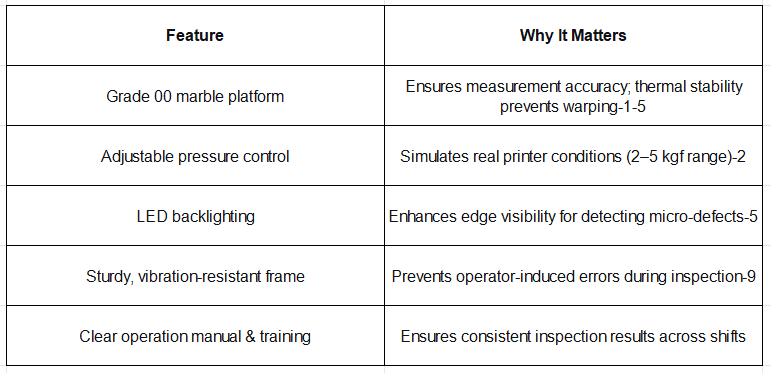
The instrument simulates the actual working conditions of a printer: the blade is lowered onto a precision surface under controlled pressure (typically 2–5 kgf), and operators visually inspect the contact line for any gaps or irregularities. A Grade 00 marble platform (flatness tolerance ≤0.005 mm) provides the reference surface, ensuring that any deviation detected is truly a blade defect, not a measurement error.
The Real Cost of Not Inspecting
Consider this: a single printing defect caused by a worn blade can lead to rework, scrap, or even field failures. Over the course of a year, the cumulative cost of these quality issues far exceeds the investment in a manual inspection instrument. Regular inspection enables:
Extended blade life – Replace blades only when they truly need it, not on an arbitrary schedule
Reduced printing defects – Catch wear before it impacts solder paste deposition
Traceable quality data – Document inspection results for process control and customer audits
Lower operational costs – Prevent wasted paste, stencil damage, and PCB scrap
What to Look for in a Manual Inspection Instrument
When evaluating instruments, prioritize these features:
The Bottom Line
Manual squeegee blade inspection is not about replacing judgment—it's about informing it with objective, repeatable data. In an industry where print quality directly determines final yield, eliminating guesswork from blade maintenance is a straightforward path to higher quality and lower costs.
A quality manual inspection instrument pays for itself many times over through reduced defects, extended blade life, and the peace of mind that comes from knowing your blades are performing as they should—every print, every shift.
Previous: Vacuum Planetary Deaeration Defoaming Mixer – Which One Is Right for You? Next: The Hidden Defect Generator in Your SMT Line: Why Squeegee Inspection Matters More Than You Think


