



News Center
The Guide to Screen Printing Squeegee Glue Grinding Machines: Boost Print Quality & Reduce Costs
 2026-06-05
 246
246
In the competitive world of screen printing, achieving consistent, high-quality results while maximizing profitability depends on attention to every detail of your production process. Among the most critical yet often overlooked tools in your arsenal is the screen printing squeegee glue grinding machine. This essential piece of equipment directly impacts your print clarity, ink deposition, squeegee lifespan, and overall production efficiency.
Whether you operate a small custom print shop or a large industrial printing facility, understanding how to select, use, and maintain a squeegee sharpener will transform your operations. This comprehensive guide covers everything you need to know about rubber squeegee grinding machines, from choosing the right model to implementing best practices that will save you time and money.
Why Professional Squeegee Grinding Is Non-Negotiable
Your squeegee blade is the heart of the screen printing process. It performs four essential functions:
Shears ink through the screen mesh
Ensures uniform contact between the screen and substrate
Controls ink deposit thickness
Removes excess ink from the screen surface
Over time, even the highest-quality polyurethane squeegees wear down. Dull, rounded edges force operators to apply excessive pressure, leading to:
Poor image definition and fuzzy details
Uneven ink coverage and color inconsistency
Increased screen stretching and premature screen failure
Slower production speeds
Higher ink consumption
More frequent squeegee replacements
A dedicated automatic squeegee grinding machine restores your blades to factory-new condition with precision that manual sharpening simply cannot match. Properly sharpened squeegees require minimal pressure, deliver crisp, consistent prints, and last up to 3-5 times longer than poorly maintained blades .
Types of Screen Printing Squeegee Grinding Machines
When shopping for a silk screen printing squeegee sharpener, you'll encounter three primary types, each with distinct advantages and applications:
1. Wheel Grinding Machines
Wheel grinders use a rotating abrasive wheel to remove material from the squeegee edge. Modern models feature diamond grinding wheels that provide exceptional durability and precision.
Key advantages:
Fast grinding speeds
Excellent edge straightness
Minimal blade deformation
Long wheel lifespan
Consistent results across different squeegee durometers
Best for: High-volume production environments and precision printing applications.
2. Belt Grinding Machines
Belt grinders use a continuous abrasive belt that moves across the squeegee surface. They come in two configurations: long-belt (stationary squeegee, moving belt) and short-belt (moving belt assembly, stationary squeegee).
Key advantages:
Lower initial cost
Good for general-purpose sharpening
Can handle various blade profiles
Easy belt replacement
Best for: Small to medium-sized shops with moderate production volumes.
3. Cutting/Shearing Systems
Cutting systems use a sharp blade to slice off a thin layer from the squeegee edge rather than grinding it away.
Key advantages:
Extremely sharp edges
No heat generation during the process
No polyurethane dust production
Simple operation with minimal skill required
Best for: Shops prioritizing edge sharpness and clean operation.
7 Critical Factors to Consider When Choosing a Squeegee Grinding Machine
Selecting the right squeegee grinder for your business requires careful evaluation of your specific needs. Here are the most important factors to consider:
1. Maximum Grinding Length
Choose a machine that can accommodate the longest squeegee you use in your operations. Common sizes range from 1000mm to 2500mm, with custom options available for specialized applications .
2. Grinding Precision
Look for machines with precision linear guide rails that ensure grinding accuracy of ±0.05mm or better. This level of precision guarantees uniform edge height across the entire length of the squeegee .
3. Adjustable Grinding Angle
The optimal grinding angle varies depending on your printing application. A machine with adjustable angles from 0° to 45° allows you to match the edge profile to your specific ink type, mesh count, and substrate .
4. Dust Collection System
Grinding polyurethane generates fine dust that can be harmful to workers and contaminate your printing environment. A built-in vacuum system with strong suction and a collection bag is essential for maintaining a clean, safe workplace .
5. Squeegee Holding Mechanism
A secure, easy-to-use clamping system ensures your squeegee remains perfectly aligned during grinding. Look for designs that can accommodate both manual and automatic press squeegees and can adjust for slightly deformed blades .
6. Automation Level
Automatic machines with programmable stroke control and reverse functions deliver consistent results with minimal operator intervention. They also reduce operator fatigue and increase productivity in high-volume settings.
7. Durability and Construction
Invest in a machine with a robust, rigid frame construction that minimizes vibration during operation. High-quality components will ensure years of reliable service with minimal maintenance.
Proper Squeegee Grinding Techniques for Optimal Results
Even the best screen printing squeegee glue grinding machine will produce poor results if used incorrectly. Follow these best practices to achieve professional-grade sharpening:
Before Grinding
Clean the squeegee thoroughly: Remove all ink, solvent, and debris from the blade. Any contaminants will damage the grinding wheel and produce uneven results.
Inspect for damage: Check for deep cuts, nicks, or chemical damage that cannot be repaired through grinding. Severely damaged blades should be replaced.
Secure the squeegee properly: Ensure the blade is clamped firmly and perfectly parallel to the grinding surface.
Set the correct angle: Maintain the original factory angle (typically 20°-30° for most applications) unless you have a specific reason to change it .
During Grinding
Use light passes: Remove only 0.05-0.1mm of material per pass. Heavy cuts generate excessive heat, which can soften the polyurethane and cause edge deformation.
Keep the grinding wheel clean: Regularly dress the wheel to remove built-up polyurethane residue and maintain its cutting efficiency.
Maintain consistent speed: Avoid rushing the process. A steady, consistent grinding speed produces the smoothest edge.
Check progress frequently: Stop periodically to inspect the edge and ensure you're removing material evenly.
After Grinding
Remove burrs: Gently deburr the edge with a fine abrasive pad to remove any loose material.
Clean again: Wipe the squeegee to remove all grinding dust before returning it to production.
Allow recovery time: Let the blade rest for 24 hours before using it. This allows the polyurethane to recover from any temporary compression during grinding .
Common Squeegee Grinding Problems and Solutions
Even experienced operators encounter issues from time to time. Here are the most common problems and how to fix them: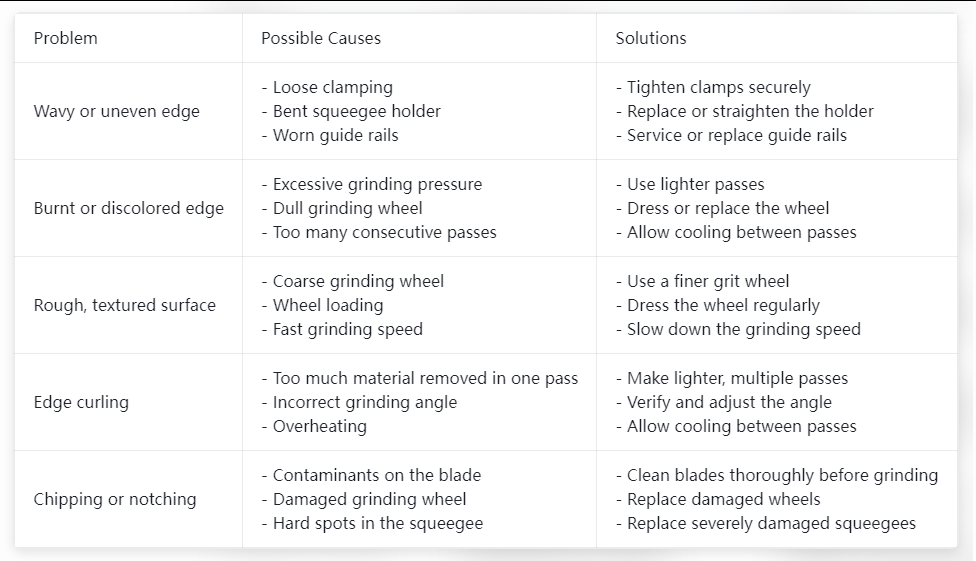
Complete Squeegee Maintenance Program
A squeegee grinding machine is just one part of a comprehensive squeegee maintenance program. Implement these practices to maximize the lifespan and performance of your blades:
1. Implement a Rotation Schedule
Rotate your squeegees every 4-8 hours of use, depending on the ink type. Aggressive solvent-based inks require more frequent rotation. This allows blades to recover from chemical exposure and reduces swelling .
2. Clean Immediately After Use
Never leave ink on your squeegees overnight. Wipe them clean with a compatible solvent immediately after removing them from the press. Never soak squeegees in solvent, as this causes excessive swelling and degradation .
3. Store Properly
Store squeegees flat in a cool, dry, dark environment at room temperature (60-70°F / 15-21°C) with 50% relative humidity. Never stand squeegees on their edges or stack heavy objects on top of them .
4. Establish a Regular Sharpening Schedule
Don't wait until your print quality suffers to sharpen your squeegees. A good rule of thumb is to sharpen after every 8-16 hours of production use. Keep detailed records of sharpening dates and blade usage to optimize your schedule.
5. Train Your Operators
Ensure all staff members understand proper squeegee handling, cleaning, and sharpening techniques. Poor handling is one of the leading causes of premature squeegee failure.
ROI Analysis: Investing in a Quality Squeegee Grinding Machine
Many print shops hesitate to invest in a professional automatic squeegee grinding machine, viewing it as an unnecessary expense. However, the financial benefits quickly outweigh the initial cost:
Cost Savings
Reduced squeegee purchases: Properly sharpened blades last 3-5 times longer
Lower ink consumption: Sharp squeegees use 15-25% less ink per print
Fewer rejected prints: Consistent quality reduces waste and rework
Increased production speed: Sharp blades allow faster press speeds
Revenue Improvements
Higher quality prints: Crisper, more consistent results lead to satisfied customers and repeat business
Expanded capabilities: Precision sharpening enables fine-detail printing and specialty applications
Reduced downtime: Less time spent troubleshooting print quality issues
For most medium-sized print shops, a quality squeegee grinding machine pays for itself within 6-12 months through these combined savings and revenue improvements.
Conclusion
A screen printing squeegee glue grinding machine is not just a luxury—it's an essential investment for any print shop serious about quality and profitability. By restoring your squeegee blades to perfect condition, you'll achieve consistent, professional results, reduce your operating costs, and extend the life of your equipment.
When selecting a machine, prioritize precision, durability, and features that match your specific production needs. Combine your investment with a comprehensive squeegee maintenance program, and you'll see immediate improvements in your print quality and bottom line.
Remember, in screen printing, the difference between a good print and a great print often comes down to the sharpness of your squeegee edge. Don't let a dull blade hold your business back.
Previous: The Guide to 900ML Vacuum Planetary Defoaming Dispersion Mixer: Boost Material Processing Efficiency Next: Subit: Your Trusted Partner for Precision Stencil Inspection Solutions in SMT Manufacturing


