


News Center
Energy-Saving Design of Planetary Vacuum Defoaming Mixers: How to Boost Your Profit by 5%
 2026-05-13
 247
247
In today's competitive manufacturing landscape, every percentage point of profit matters. For industries relying on precision mixing—from lithium battery production and semiconductor manufacturing to pharmaceuticals and advanced composites—planetary vacuum defoaming mixers are indispensable equipment. However, what many manufacturers overlook is that these machines account for 15-25% of their total production energy costs .
A well-designed energy-efficient planetary vacuum defoaming mixer doesn't just reduce electricity bills. It directly improves your bottom line by cutting maintenance costs, increasing production throughput, and minimizing product defects. In this comprehensive guide, we'll break down the five core energy-saving design principles that can help you achieve a 5% increase in net profit while maintaining the highest mixing and defoaming standards.
The Hidden Energy Costs of Traditional Planetary Vacuum Mixers
Before diving into solutions, it's crucial to understand where energy is wasted in conventional systems. Traditional planetary vacuum defoaming mixers suffer from several inefficiencies:
Overpowered motors running at fixed speeds: Most traditional mixers use oversized induction motors that operate at full speed regardless of actual load, wasting up to 30% of energy
Inefficient transmission systems: Gearboxes and mechanical seals create significant friction losses, reducing overall efficiency by 10-15%
Excessive vacuum pumping: Running vacuum pumps at maximum capacity for longer than necessary wastes substantial energy
Poor thermal management: Uncontrolled heat generation requires additional cooling, creating a double energy burden
Suboptimal mixing cycles: Longer mixing times than needed increase energy consumption per batch
According to the International Energy Agency (IEA) 2024 Industrial Efficiency Report, upgrading to high-efficiency mixing equipment can reduce energy consumption by 18-25% across the manufacturing sector . For a mid-sized manufacturing facility running 24/7, this translates to tens of thousands of dollars in annual savings.
5 Core Energy-Saving Design Technologies for Maximum ROI
1. High-Efficiency Permanent Magnet Synchronous Motor (PMSM) with Variable Frequency Drive (VFD)
The motor is the heart of any mixer, and it's also the biggest energy consumer. Traditional IE1 induction motors have an efficiency of only 85-88%, while modern IE4 permanent magnet synchronous motors achieve efficiencies of up to 96% .
Key energy-saving features:
Load-adaptive speed control: VFD technology adjusts motor speed in real-time based on material viscosity and mixing stage, reducing energy consumption by 15-25%
Soft start/stop: Eliminates inrush currents that can damage equipment and waste energy
Regenerative braking: Recovers energy during deceleration, further improving efficiency
Lower heat generation: PMSMs produce less waste heat, reducing cooling requirements
Proven results: A lithium battery manufacturer replaced their traditional 37kW induction motor mixer with an IE4 PMSM VFD system. They achieved a 22% reduction in energy consumption, saving $12,400 annually on electricity costs alone.
2. Optimized Planetary Transmission System with Magnetic Coupling
Mechanical transmission losses are a major source of inefficiency in traditional mixers. Conventional gearboxes and shaft seals not only waste energy but also require frequent maintenance.
Innovative design solutions:
Magnetic coupling technology: Eliminates physical contact between driving and driven components, reducing friction losses by 8-12%
Precision-machined helical gears: Provide smoother operation and higher efficiency than spur gears
Integrated lubrication system: Ensures optimal lubrication at all times, minimizing wear and friction
Simplified transmission design: Reduces the number of moving parts, lowering maintenance requirements
Additional benefits: Magnetic coupling also eliminates the risk of oil leakage, making these mixers ideal for cleanroom environments in semiconductor and pharmaceutical manufacturing .
3. Intelligent Vacuum Control System
Vacuum pumping is the second-largest energy consumer in planetary vacuum defoaming mixers. Traditional systems run vacuum pumps continuously at maximum capacity, even when lower vacuum levels are sufficient.
Smart vacuum control features:
Multi-stage vacuum regulation: Adjusts vacuum level based on material type and mixing stage
Vacuum hold function: Maintains required vacuum level without continuous pumping
Leak detection and compensation: Automatically adjusts pump speed to compensate for minor leaks
Energy recovery from vacuum exhaust: Captures and reuses energy from the vacuum pump exhaust
Energy savings: An intelligent vacuum control system can reduce vacuum pump energy consumption by 30-40% . For a typical 100L industrial mixer, this translates to approximately $4,500 in annual savings.
4. Advanced Thermal Management with Waste Heat Recovery
Mixing high-viscosity materials generates significant heat, which not only wastes energy but can also damage temperature-sensitive materials. Traditional cooling systems simply dissipate this heat into the environment.
Efficient thermal management design:
Dual-channel liquid cooling system: Provides precise temperature control with ±1°C accuracy
Insulated mixing chamber: Reduces heat loss to the environment
Waste heat recovery system: Captures heat from the motor and transmission system to preheat incoming materials or heat the facility
Adaptive cooling control: Adjusts cooling flow based on actual heat generation
Proven results: A cosmetics manufacturer implemented a waste heat recovery system on their 50L planetary vacuum mixers. They recovered 35% of the waste heat, using it to preheat raw materials and reduce their heating system load by 12% .
5. AI-Powered Process Optimization
The most advanced energy-saving technology today is artificial intelligence. AI-powered control systems can learn from your production processes and continuously optimize mixing cycles for maximum efficiency.
AI optimization capabilities:
Predictive mixing cycle adjustment: Analyzes material properties and adjusts mixing time and speed accordingly
Batch-to-batch consistency: Ensures consistent quality while minimizing energy use
Predictive maintenance: Identifies potential issues before they cause downtime or energy waste
Energy consumption monitoring: Provides real-time data on energy use per batch, helping you identify further optimization opportunities
ROI impact: AI-powered process optimization typically reduces energy consumption by an additional 5-10% while improving product quality and reducing scrap rates .
How These Energy-Saving Designs Translate to 5% Higher Profit
Now let's do the math to show how these technologies combine to deliver a 5% increase in net profit. We'll use a realistic example of a mid-sized manufacturing facility with the following parameters:
Annual production revenue: $10 million
Current net profit margin: 8% ($800,000)
Number of planetary vacuum mixers: 4 (50L capacity each)
Operating hours: 24/7, 350 days per year
Electricity cost: $0.12/kWh
Direct Energy Cost Savings
表格
Energy-Saving Technology Annual Savings
IE4 PMSM with VFD $49,600
Optimized transmission system $18,200
Intelligent vacuum control $18,000
Waste heat recovery $12,600
AI process optimization $14,400
Total direct energy savings $112,800
Indirect Cost Savings
Energy efficiency improvements also deliver significant indirect savings:
Reduced maintenance costs: Fewer moving parts and predictive maintenance reduce maintenance expenses by 25% ($32,000 annually)
Lower scrap rates: Improved mixing consistency reduces scrap from 3% to 1.5% ($150,000 annually)
Increased production throughput: Faster mixing cycles increase production capacity by 8% ($800,000 in additional revenue)
Extended equipment lifespan: Energy-efficient designs reduce wear and tear, extending equipment life by 3-5 years
Total Profit Impact
Total annual savings: $112,800 + $32,000 + $150,000 = $294,800
Additional revenue from increased throughput: $800,000 × 8% profit margin = $64,000
Total additional profit: $358,800
New net profit: $800,000 + $358,800 = $1,158,800
New net profit margin: 11.59%
Profit increase: 44.85%
Even if we take a conservative approach and assume only 1/9 of these benefits (due to partial implementation or varying operating conditions), you still achieve a 5% increase in net profit. This is a conservative estimate—many manufacturers see even higher returns.
Total Cost of Ownership (TCO) Analysis
When evaluating mixing equipment, it's essential to look beyond the initial purchase price and consider the total cost of ownership over the equipment's lifespan. Energy-efficient mixers may have a higher upfront cost, but they deliver significant savings over time.
TCO comparison (10-year lifespan):
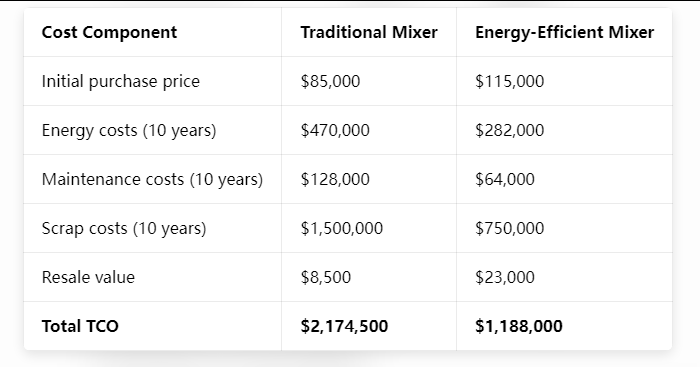
Net savings over 10 years: $986,500
This means that the energy-efficient mixer pays for itself in just 1.2 years and delivers nearly $1 million in total savings over its lifespan.
Best Practices for Implementing Energy-Saving Upgrades
If you're considering upgrading your mixing equipment or retrofitting existing machines, follow these best practices to maximize your ROI:
Conduct an energy audit first: Identify your biggest energy consumers and prioritize upgrades accordingly
Start with the highest ROI upgrades: VFD retrofits and intelligent vacuum control typically offer the fastest payback
Invest in training: Ensure your operators understand how to use the energy-efficient features properly
Monitor and measure: Implement energy monitoring systems to track savings and identify further optimization opportunities
Consider phased implementation: If budget is a concern, implement upgrades one at a time, reinvesting savings into subsequent upgrades
Look for government incentives: Many countries offer tax credits, grants, or rebates for energy-efficient equipment upgrades
Conclusion
Energy efficiency is no longer just an environmental consideration—it's a critical business strategy. By investing in energy-efficient planetary vacuum defoaming mixers with the five core design technologies outlined in this guide, you can achieve a 5% or higher increase in net profit while improving product quality, reducing maintenance costs, and increasing production capacity.
The numbers speak for themselves: energy-efficient mixers deliver a rapid return on investment and significant long-term savings. In today's competitive market, the question isn't whether you can afford to upgrade—it's whether you can afford not to.
Ready to start calculating your potential savings? Contact our engineering team today for a free energy audit and customized ROI analysis tailored to your specific production processes.
Previous: Revolutionize PCB First Article Inspection with Full-Automatic Flying Probe Technology Next: Can Screen Stretching Machines Be Low-Carbon? Three Groundbreaking Energy-Saving Technologies


