


News Center
Revolutionize PCB First Article Inspection with Full-Automatic Flying Probe Technology
 2026-05-12
 261
261
First article inspection (FAI) is the critical quality gate between production setup and mass manufacturing in electronics. However, traditional manual FAI has become a major bottleneck for PCB assembly facilities, with complex boards taking 2-4 hours to inspect and suffering from human error, poor traceability, and inability to handle miniaturized components.
The full-automatic flying probe first-article detecting machine solves these challenges, delivering unprecedented speed, accuracy, and reliability while transforming your quality control process.
What Is a Full-Automatic Flying Probe FAI Machine?
This advanced quality control system uses software-controlled robotic probes to perform comprehensive electrical and visual inspection of first article PCB assemblies. Unlike bed-of-nails testers, it requires no custom fixtures.
All-in-one capabilities include:
High-precision robotic probe arms
4-wire LCR bridge measurement technology
High-resolution optical inspection
Intelligent data analysis and reporting
Automated board handling
How It Works
The streamlined automated workflow:
Data Import: Import Gerber, ODB++, and BOM files to automatically generate test programs in minutes
Automated Loading: Consistent board positioning without manual intervention
Electrical Testing: Independent probes test continuity, resistance, capacitance, inductance, and diode functionality
Optical Inspection: HD cameras verify component presence, polarity, alignment, and solder joint quality
Reporting: Automatic defect flagging with precise locations and comprehensive digital reports
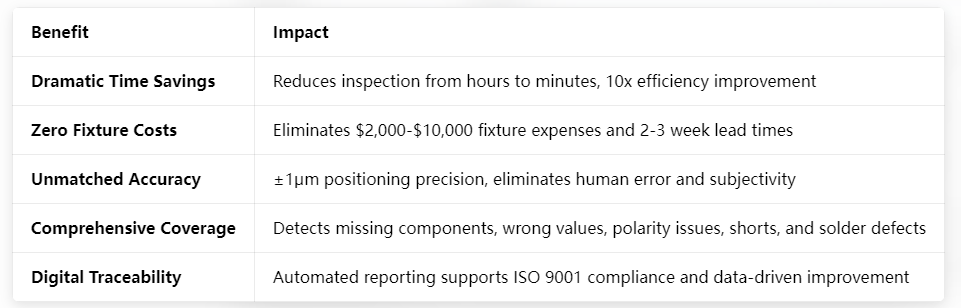
Key Advantages Over Traditional Methods
Ideal Application Scenarios
New Product Introduction (NPI) with frequent design changes
High-mix, low-volume manufacturing
High-density PCB assembly with miniaturized components
Medical, aerospace, and automotive electronics with strict quality requirements
Rapid prototyping where time-to-market is critical
Best Practices to Maximize Value
Standardize Gerber, ODB++, and BOM file formats
Optimize test programs to prioritize critical components
Integrate with your Quality Management System (QMS)
Provide comprehensive operator training
Use inspection data for continuous process improvement
The Future of FAI
Ongoing advancements in AI-powered defect detection, faster robotic movement, and enhanced manufacturing integration will further expand the capabilities of flying probe FAI systems. As electronics become smaller and more complex, automated inspection will become essential for maintaining competitiveness.
Conclusion
Investing in a full-automatic flying probe first-article detecting machine is a strategic decision that directly impacts your bottom line. By reducing inspection time by up to 90%, eliminating fixture costs, and improving defect detection rates, this technology gives you a significant competitive advantage in today's demanding electronics manufacturing market.
Previous: Formwork Scraper Machine: The Complete Guide to Efficient Concrete Formwork Maintenance Next: Energy-Saving Design of Planetary Vacuum Defoaming Mixers: How to Boost Your Profit by 5%


