



News Center
How Stencil Inspection Systems Improve SMT Print Quality and Reduce Costly Defects
 2026-11-10
 103
In surface-mount technology (SMT) manufacturing, solder paste printing accounts for over 60% of end-of-line assembly defects. The vast majority of these failures trace back to one often-overlooked factor: degraded stencil condition.
Clogged apertures, residual solder paste, burrs, physical damage, and dropping tension frequently evade routine visual checks. When compromised stencils reach the printer, they cause insufficient solder, bridging, misaligned deposits, and weak joints — leading to expensive rework, material scrap, unplanned downtime, and customer quality complaints.
Most SMT facilities only validate stencils upon incoming receipt, ignoring gradual wear and contamination during daily use, cleaning, handling, and storage. This reactive approach turns minor, fixable stencil issues into costly production crises.
An automated stencil inspection system resolves this by transforming stencil management from reactive maintenance into predictive, data-backed process control. Below is how it delivers measurable quality and efficiency gains for SMT lines.
1. Eliminate Micro Aperture Defects Before They Impact Printing
Manual visual inspection is unreliable for fine-pitch stencils, especially with apertures as small as 60μm. Tiny blockages, foreign particles, and paste residues are easy to miss, yet they directly cause print defects that only appear at downstream testing.
Automated optical inspection delivers consistent, high-precision detection with ±10μm repeat accuracy. At just 1 second per field of view, it supports fast, high-frequency checks: post-cleaning verification, pre-changeover validation, re-inspection after high-volume runs, and condition checks before warehousing.
By catching every aperture-level abnormality upstream, manufacturers drastically reduce solder paste-related defects and the rework costs that come with them.
2. Ensure Consistent Print Uniformity With Tension & Condition Monitoring
Stencil tension and flatness degrade slowly over repeated use and cleaning cycles. Uneven tension leads to inconsistent solder paste thickness, poor deposit uniformity, and unreliable solder joint quality — problems that are hard to trace and expensive to correct mid-run.
Traditional manual tension testing is infrequent and operator-dependent. An integrated inspection system performs multi-point tension measurements with ±1N/cm² accuracy (0–60N range), tracking condition trends over time.
Early alerts for declining tension or flatness issues let teams schedule refurbishment or replacement before quality drifts, keeping print output stable across every production batch.
3. Digitize Stencil Management for Full Lifecycle Traceability
Paper logs and fragmented records make it impossible to enforce standardized maintenance or identify long-term wear patterns. A modern stencil inspection system digitizes the entire workflow for complete visibility:
QR code-based stencil identification for instant access to templates and historical data
Inspection history tracking for every stencil across its full service life
Data-driven cleaning cycle management aligned with actual usage and contamination levels
Automatic report generation for quality audits and compliance
MES integration to sync stencil quality data with factory-wide production systems
Every inspection result becomes a permanent digital quality record, enabling end-to-end traceability across the stencil lifecycle. This turns ad-hoc, reactive fixes into predictable, preventive process control.
4. Integrate Seamlessly for Closed-Loop SMT Workflow
Unlike stencil verification tools built for incoming quality control (which require complex Gerber file programming), process-focused inspection systems build standard templates directly from pre-qualified, production-ready stencils. No specialized CAM skills are required.
This makes the system easy to adopt for frontline production staff, and it enables true closed-loop stencil management when paired with stencil cleaners, MES platforms, and smart storage systems: a continuous workflow of use → cleaning → inspection → evaluation → recording → storage → reuse.
It aligns with fast-paced SMT production rhythms, supporting high-frequency daily checks without slowing down line changeovers or output.
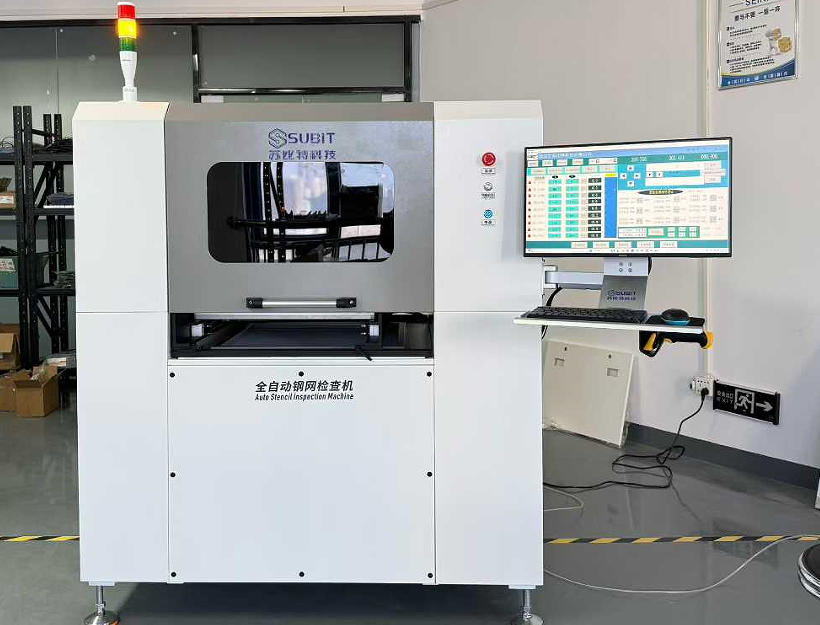
The SUBIT SBT-JC1009SA: Built for Daily SMT Process Control
At Shenzhen SUBIT Technology, we engineered the SBT-JC1009SA Automatic Stencil Inspection Machine specifically for on-floor SMT process quality management — not just first-article stencil acceptance.
Key advantages for SMT manufacturers:
No Gerber file import required; templates created from approved production stencils
Fast inspection cycles for high-frequency daily use
Simple operation with low training barriers for shop-floor teams
Full digital lifecycle management with MES connectivity
Industrial-grade stainless steel build for reliable, long-term factory use
Every unit is fully assembled, calibrated, and tested before shipment. Backed by a 12-month whole-machine warranty, lifetime free software upgrades, and 24/7 technical support with 8-hour response times, SUBIT delivers trusted, cost-effective stencil inspection solutions for SMT facilities worldwide.
Ready to Cut Print Defects and Boost Your Line Yield?
If you want to reduce rework costs, standardize stencil management, and shift from reactive troubleshooting to proactive quality control, we can help.
Contact our team today to request full specifications, discuss your facility’s unique needs, or schedule a remote demonstration of the SBT-JC1009SA stencil inspection system.
Previous: Screen Stretching Machine Tension Accuracy: Why ±0.5 N Matters More Than “Max Tension” Next: no more


