



News Center
Manual vs. Automatic Stencil Inspection: Where Small SMT Lines Actually Break Even
 2026-11-06
 105
Most small-to-mid SMT lines assume automatic stencil inspection is only for high-volume factories. That assumption is expensive.
The break-even point is not about how many boards you build per day. It is about how much one undetected stencil defect costs after it reaches the printer—and how often that happens on your line.
Manual Inspection Misses More Than It Catches
A manual check can spot a fully blocked aperture. It cannot reliably catch a partially clogged 60 μm hole, a tension drop from 42 to 36 N/cm², or a burr that fails after 200 strokes.
It also leaves no objective record. When a bridging defect appears three days later, no one can prove whether the stencil was already degrading before it went onto the printer. The cost moves downstream—to rework, scrap, and unplanned downtime.
The Real Break-Even Calculation
Forget throughput-based ROI models. For a line running 3–10 stencil changeovers per day, the math comes down to one prevented defect escape per month.
Even at a modest $300–$800 per incident, that is $3,600–$9,600 per year—before expedited rework or customer returns. Add tension-related print drift that manual checks miss entirely, and the payback window closes fast.
The break-even point arrives the first time an automatic system catches a stencil that manual inspection would have passed—and you have the data to prove it.
“Fully Automatic” Does Not Mean “Gerber-Dependent”
The common objection is practical: “We do not have engineering bandwidth to import Gerber files for every stencil.”
That is valid for CAD-comparison platforms. It is not true for template-based inspection.
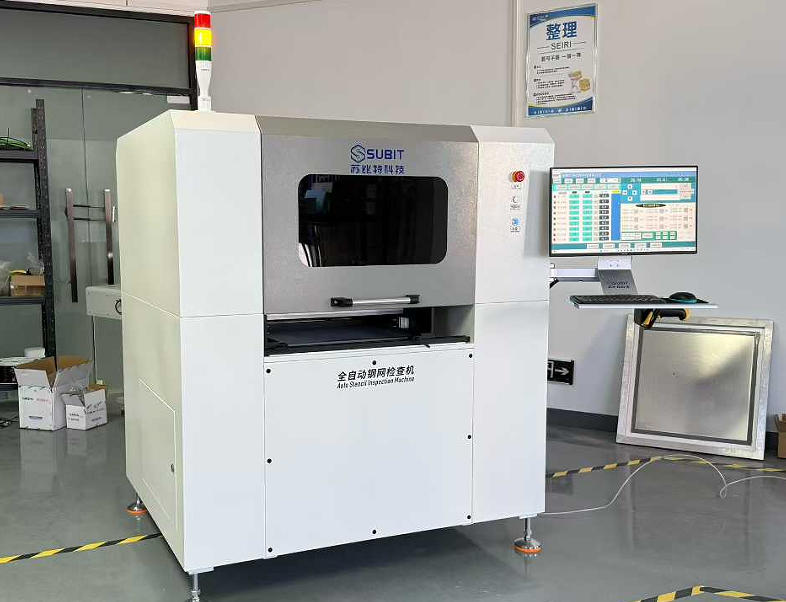
The SUBIT SBT-JC1009SA creates a standard template from a physically approved stencil that already passed incoming inspection. The operator selects the stencil, loads the matching template, and runs the check. No Gerber import. No CAM programming on the SMT floor. Standard floor personnel can complete the inspection with minimal training.
What You Actually Buy: A Closed-Loop Stencil Record
The financial case gets stronger when inspection results become lifecycle data, not isolated pass/fail judgments.
With the SBT-JC1009SA, every inspection is tied to a stencil through QR-code identification. The system tracks inspection history, cleaning cycles, and tension changes per stencil. Results are automatically compiled into inspection reports and uploaded to MES.
Every inspection becomes part of a digital quality record, enabling complete traceability across the stencil lifecycle. This is how stencil management moves from reactive maintenance to predictive process control—flagging a stencil before it generates a defect, not after.
The Practical Takeaway
Do not compare manual inspection time with machine cycle time. Compare the cost of one stencil-related defect escape per month against the cost of the system—then ask how many escapes your manual process has already missed because no one was recording the data.
If your line changes stencils daily, cleans on a fixed cycle, and still discovers printing problems only after boards are built, manual inspection has already passed its break-even point. The only question is whether the next detection happens before the printer or after the rework station.
Shenzhen SUBIT Technology Co., Ltd.
SBT-JC1009SA Automatic Stencil Inspection Machine — template-based inspection, QR-code traceability, automatic reporting, and MES integration for SMT lines that need evidence, not guesswork.
Contact our team for a process consultation or a live demo based on your stencil mix and line configuration.
Previous: Stop Losing Yield to Bubbles: 5 Specs That Actually Matter in a Vacuum Planetary Mixer Next: Your Ink Settled Again? The Drum Roller Mixer That Ends Manual Shaking Before Every Print Run


