



News Center
Exposure Machine for Screen Printing: How to Choose the Right One in 2026
 2026-11-05
 106
If you've ever burned a screen and found the detail washed out, the emulsion peeling, or the stencil inconsistent run after run, the problem is rarely the emulsion — it's usually the exposure machine.
As a manufacturer building UV exposure equipment for screen printing shops in Shenzhen, we see the same mistakes over and over: shops buy based on price alone, then wonder why their halftones won't hold a 5% dot. This guide walks through what actually matters when you evaluate an exposure unit.
1. What a screen printing exposure machine actually does
A UV exposure unit uses ultraviolet light to polymerize the photosensitive emulsion on your screen. A vacuum pulls the film positive tight against the glass, ensuring zero gap between the artwork and the emulsion — that's what gives you sharp edges and fine detail.
The two variables that define output quality are:
How evenly the UV light reaches every point on the screen
How completely the film positive stays in contact with the emulsion during exposure
Everything else — PLCs, touchscreens, fancy housing — supports those two things.
2. Five specs you should actually compare
When suppliers send you a quote, don't just compare price. Compare these five points:
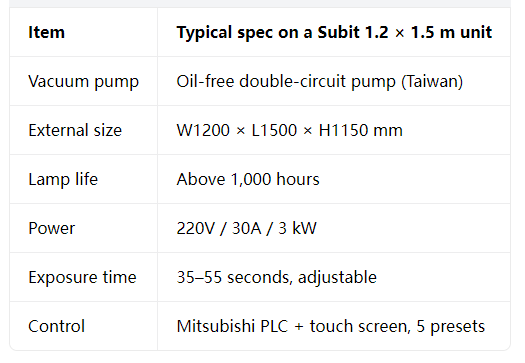
a) Vacuum systemWeak vacuum = light leak between film and glass = fuzzy edges. Look for a double-circuit oil-free pump (like the Taiwan-made units we spec on the Subit E-1500). Oil-free means less maintenance and no contamination on your glass; double-circuit means the blanket pulls down faster and holds pressure during the full 35–55 second exposure window.
b) UV light source & lamp lifeCheap machines use domestic tubes that drop in UV output after 200–300 hours. A 3 kW high-quality UV lamp imported from Korea will hold output past 1,000 hours. That matters: when lamp output fades, shops overexpose to compensate — and that kills your fine detail.
c) Exposure uniformityAsk the supplier: what's the light uniformity across the screen area? On our W1200 × L1500 mm unit, the goal is within ±5% across the whole table. If they can't give you a number, treat it as a red flag.
d) Control systemA Mitsubishi PLC + touch screen isn't a luxury — it means repeatability. You want the machine to store at least 5 exposure presets (one per mesh count / emulsion type) and to self-diagnose faults instead of just dying mid-job. That's what lets your newest operator match your most experienced one.
e) Glass and blanket quality
Glass should be ultra-white tempered — regular greenish glass filters UV unevenly.
The vacuum blanket should be German-made for real toughness. A cheap blanket cracks in 6 months, and replacing it means losing the flatness you paid for.
3. Three common mistakes we see in print shops
Exposing by feel, not by test strips. Always do a step-wedge exposure test on a new mesh/emulsion batch. Set the time once, then lock it in as a preset.
Ignoring lamp aging. Log your lamp hours. When you pass ~900 hours, start planning a replacement — don't wait until the stencils tell you.
Skimping on the air filter. Every vacuum pump needs a filter; a clogged one slows down the pull-down and wastes 5–10 seconds per screen.
4. Quick maintenance routine (under 10 minutes a day)
Wipe the exposure glass with a lint-free cloth after every shift
Check the vacuum blanket for pinholes weekly
Log lamp hours and reset the counter on replacement
Run the pump for 30 seconds at start-up to purge condensate
5. Typical machine specs we ship to shops
Wrapping up
A good exposure machine isn't the cheapest line item on your shop's capex list — but it's the one that decides whether every screen you burn is profitable or scrap. Compare vacuum, lamp quality, uniformity, control and consumables before you compare price.
If you're evaluating units for a new shop or replacing an old exposure box, send us your screen size and typical mesh counts — we'll send back a spec sheet and a recommended exposure time range, no obligation.
→ Contact Subit (Shenzhen) for a quote
Previous: How to Choose a Screen Printing Exposure Machine: Why 3kW Double-Vacuum System Cuts Your Reject Rate Next: How to Choose a Lotion Coating Machine: A Factory Engineer’s Checklist (With Real Specs)


