



News Center
Stencil Tension Doesn’t Fail Overnight: What the Decay Curve Tells You Before Printing Does
 2026-10-30
 107
For SMT manufacturing teams, stencil tension failure often feels like a sudden crisis. One shift the print process runs smoothly; the next, you’re facing misaligned deposits, solder bridging, and a wave of scrapped boards — all traced back to a stencil that has dropped below specification.
But the hard truth is: stencil tension never fails overnight.It degrades slowly and predictably along a consistent decay curve. The only question is whether your process captures that signal before it turns into production loss.
The Silent Gradual Decay of SMT Stencil Tension
Every stencil loses tension over time. Repeated squeegee pressure during printing, mechanical stress from cleaning cycles, handling during changeovers, and even long-term storage all contribute to gradual material fatigue.
This decline never happens as a single drop. It follows a predictable path:
Optimal tension on a newly qualified stencil
Slow, steady degradation through normal use
A gradual slide into the marginal performance zone
An eventual drop below the acceptable threshold
Most SMT facilities only catch this problem at the final stage — after defects appear. Routine manual spot-checks, scheduled weekly or monthly, leave large visibility gaps. A stencil can slip into marginal tension days before your next test, producing substandard prints and wasting solder paste, components, and production time.
Industry data consistently shows that roughly 15–20% of SMT print defects root back to undetected stencil tension lossThese are avoidable issues — if you can read the decay curve.
What the Tension Decay Curve Tells You (Before Defects Hit)
When you log consistent tension measurements across a stencil’s lifecycle, you get more than a pass/fail number. You get actionable insight that lets you shift from reactive repair to proactive control.
1. Predict remaining service life with accuracy
A clear decay trend lets you forecast exactly when a stencil will reach your tension limit. Instead of scrapping stencils early “to be safe” or running them until they cause defects, you can maximize usable life while eliminating risk. For high-mix facilities with large stencil inventories, this directly reduces consumable costs.
2. Flag abnormal wear and process issues
Stencils of the same type, used at similar frequency, should decay at comparable rates. When one stencil shows a sharply faster tension drop, it’s an early warning — often pointing to aggressive cleaning parameters, mishandling during changeover, or improper storage. Catching these patterns lets you correct process errors before they damage more stencils.
3. Right-size your cleaning and maintenance cycles
Fixed, one-size-fits-all maintenance schedules are inherently wasteful. Some stencils get inspected more often than needed; others sit in the marginal zone too long. Decay curve data lets you tailor inspection and cleaning frequencies to actual usage, cutting unnecessary downtime while upholding quality standards.
Turning Decay Data Into Predictive Stencil Management
The value of tension decay tracking is widely understood — but most SMT lines still don’t implement it. The reason is simple: manual tension testing is slow, labor-intensive, and produces disconnected data that never gets compiled into usable trends.
This is where automated stencil inspection closes the gap.
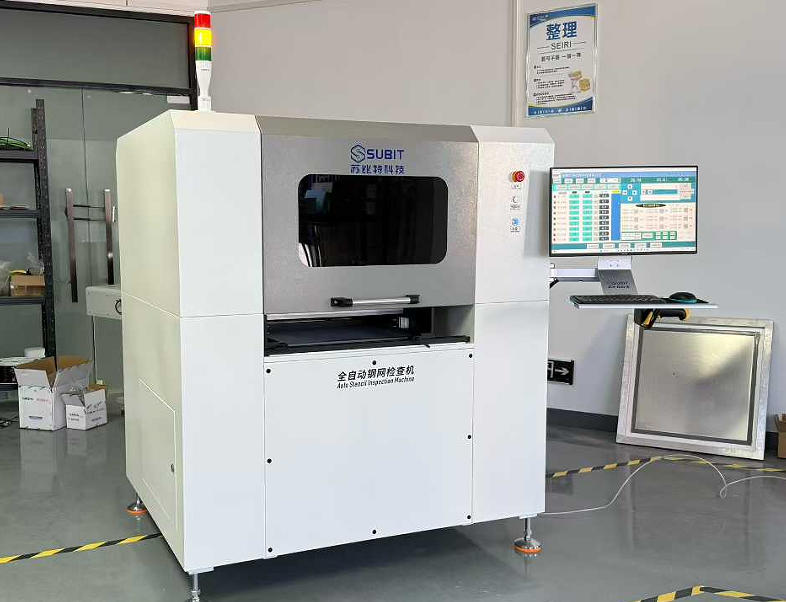
At Shenzhen SUBIT Technology, our SBT-JC1009SA Automatic Stencil Inspection Machine is built to turn routine stencil checks into continuous, data-driven process control. Designed for high-frequency use on the SMT shop floor, it delivers fast, repeatable results without reliance on Gerber file imports or complex programming.
Key capabilities that make decay-based management practical:
QR code-based stencil identification: Scan to instantly pull up a stencil’s full history, with no manual data entry.
Inspection history tracking: Every tension reading, cleanliness check, and defect record is stored digitally, automatically building a complete decay curve for each stencil.
High-precision tension testing: Multi-position testing with ±1N/cm² accuracy delivers reliable, consistent data you can trust for trend analysis.
Cleaning cycle management: Set rules based on actual stencil condition, not just calendar days, to trigger cleaning or maintenance alerts.
Automatic report generation: Standardized inspection reports are generated after every run for full quality traceability.
MES integration: Seamlessly connect stencil data to your MES system for end-to-end lifecycle visibility across use, cleaning, inspection, and storage.
Every inspection result becomes part of a permanent digital quality record. This transforms stencil management from reactive fire-fighting into predictive process control — while also checking for clogged apertures, foreign residue, burrs, and physical damage in the same fast cycle.
Start Seeing the Curve Before It Becomes a Crisis
Stencil tension failure is not a random event. It’s the end of a process you can see coming — if you have the right data.
For SMT factories looking to reduce print defects, cut stencil consumable costs, and stabilize process yield, moving to automated, data-backed stencil inspection is one of the highest-ROI upgrades you can make.
If you’re ready to see how the SBT-JC1009SA can bring predictive stencil management to your line, contact our team today for a tailored assessment or book a live demo to see tension decay tracking in action.
Previous: How a Full Auto Screen Exposure Machine With Touch Screen Cuts PCB Exposure Time by 60% Next: 30% of Your Print Defects Start at the Stretching Machine — Here’s How to Eliminate Them


