



News Center
SMT First Article Detector vs AOI: One Checks “Right or Wrong,” the Other Checks “Good or Bad”
 2026-10-28
 103
In SMT manufacturing, first article inspection and automated optical inspection (AOI) are both indispensable quality control tools — but they serve completely different core purposes. Many production teams mistakenly treat them as interchangeable, leading to unaddressed batch risks, misplaced investment and avoidable scrap costs.
As a Shenzhen-based SMT equipment manufacturer with years of on-site industry experience, Subit breaks down the key distinctions below to help you build a more efficient, risk-resistant quality control workflow.
Core Mission: Correctness Verification vs. Process Quality Inspection
The most fundamental difference lies in what each system is designed to validate.
SMT First Article Detector: Confirm It’s Built Correctly
A first article detector (FAI equipment) exists to answer one critical question before mass production starts: Is this first assembly made exactly as the design and BOM require?
Deployed during product changeover, new product introduction (NPI) or material batch replacement, it cross-checks the physical board against your official BOM, XY coordinate files and component specifications to catch systematic, full-batch errors.
Take our Subit JD-FAI955 as a typical intelligent FAI solution. Its inspection scope covers:
BOM discrepancies: wrong components, missing parts, extra placement
Program errors: duplicate positions, missing or misdefined XY coordinates
Placement errors: reversed polarity, flipped components, circuit board rotation
Electrical parameter validation: on-board resistance, capacitance and inductance measurement via integrated high-precision LCR bridge, to identify incoming material defects
Compatibility with solder paste boards, pertinax boards, red rubber boards and more
In short, it catches “wrong product” errors that would cause entire production batches to be scrapped.
AOI: Confirm It’s Built Well
Automated Optical Inspection (AOI) is a vision-based system that answers a different question: Does this individual assembly have visible process defects?
Deployed after solder paste printing, component placement or reflow soldering, AOI scans boards for appearance-related process flaws:
Solder defects: bridging, insufficient solder, cold joints, solder balls
Placement defects: component offset, tombstoning, skewing, side standing
Print defects: solder paste misalignment, smearing
AOI evaluates soldering and placement quality — it cannot verify whether a component matches the BOM part number, or if its electrical value meets specification.
Key Differences At A Glance
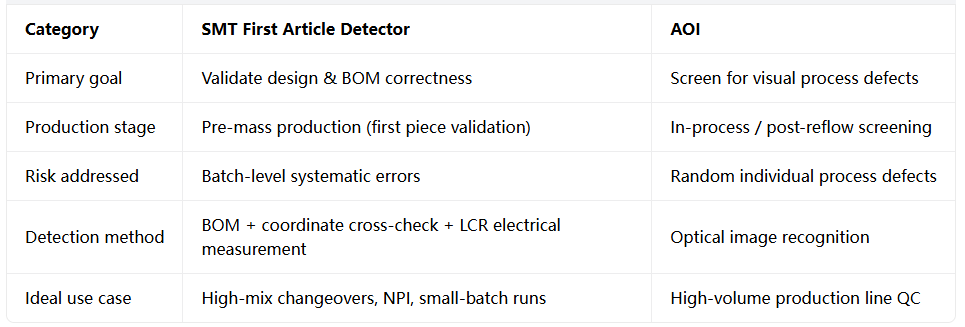
Why Neither Can Replace the Other
A common and costly misconception is that AOI can handle first article inspection on its own.
AOI can confirm a component is soldered neatly in place, but it will never detect if the wrong resistor value was loaded, or if the placement program has a coordinate offset. An entire batch of perfectly soldered boards is still worthless if the product itself is built incorrectly.
Likewise, first article inspection only confirms your initial production setup is correct. It cannot replace AOI for catching random process variations that naturally occur during full production runs.
For high-mix, low-volume SMT facilities with frequent changeovers, a smart first article detector delivers especially fast ROI: it cuts manual first article inspection time from hours to minutes, reduces labor costs, eliminates human checking error, and creates fully traceable digital inspection records.
Your Reliable FAI Solution: Subit JD-FAI955
The JD-FAI955 is Subit’s intelligent first article detector, engineered to solve the long-standing pain points of SMT sample inspection: long cycle time, high labor cost, incomplete test coverage, high error rate and poor traceability.
Its core hardware combines an industrial computer and a high-precision LCR bridge, fully integrated via our self-developed software system to deliver fast, accurate measurement of resistance, capacitance and inductance alongside full BOM and coordinate verification.
Ready to Cut Changeover Time and Eliminate Batch Errors?
If you’re looking to upgrade your pre-production quality control, our technical team can provide a tailored assessment for your SMT line. Contact us today for a free consultation, full product specifications and a detailed demo of the JD-FAI955 first article detector.
Previous: Why Your Screen Tension Drops After Stretching — 4 Fixes That Actually Work Next: Solder Paste Storage Management System vs. Regular Refrigerator


