



News Center
Manual Stencil Inspection: Hours of Work, Still Missed Defects? What Automation Delivers
 2026-10-27
 117
For most SMT manufacturing facilities, manual stencil inspection is a persistent, costly bottleneck. A full inspection of one production stencil takes anywhere from 30 minutes to 4 hours — varying with stencil size, aperture density, and operator experience — and even the most skilled technicians consistently miss subtle flaws: clogged micro-apertures, residual solder paste, edge burrs, or gradual tension loss.
These missed defects do not stay on the stencil. They cascade into print inaccuracies, board rework, scrapped assemblies, and unplanned line downtime. What many SMT teams underestimate is that automatic stencil inspection is not just “a faster way to check stencils.” It is a fundamental upgrade to how you control quality, manage assets, and reduce production risk.
The Hidden Costs of Sticking to Manual Checks
Beyond the obvious time drain, manual inspection creates three ongoing, under-measured costs:
Inconsistent, unreliable results — Human fatigue, lighting variations, and skill gaps create uneven detection rates. Defects smaller than 100μm are often overlooked entirely, and pass/fail judgments vary from shift to shift.
No traceable quality history — Paper logs or scattered digital notes make it impossible to track stencil degradation over time, validate cleaning effectiveness, or produce auditable quality records for customers.
Reactive, wasteful maintenance — You only discover a stencil problem after it causes production defects. By that point, the cost in material waste, rework hours, and lost throughput is already locked in.
What Automatic Stencil Inspection Actually Buys You
Speed is the obvious benefit, but the real return on investment comes from four structural improvements to your process.
1. Consistent, Micron-Accurate Defect Detection, Every Run
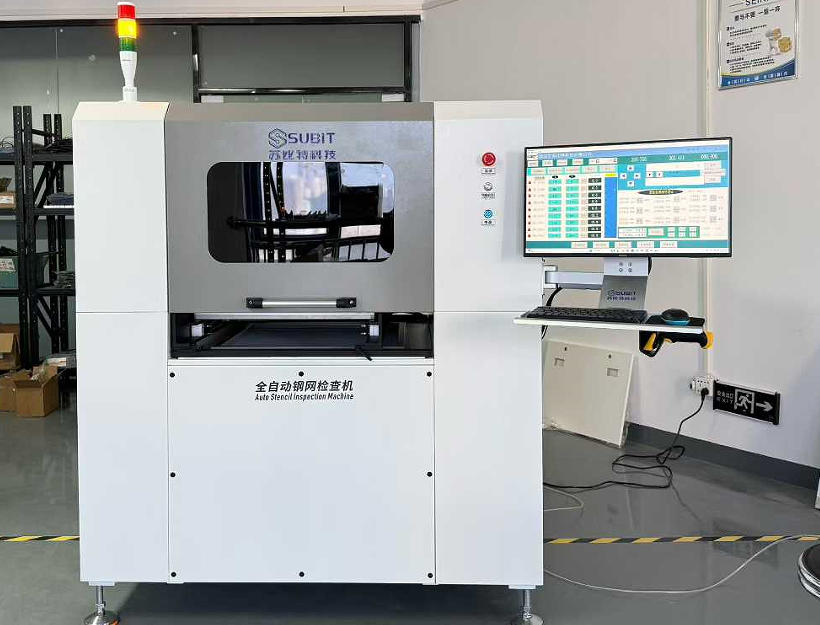
Automated systems eliminate human variability from the inspection loop. For example, the SUBIT SBT-JC1009SA detects apertures as small as 60×60μm with ±10μm repeatability, reliably identifying clogs, foreign objects, burrs, and physical damage that manual checks miss.
At 1 second per field of view (FOV), a full stencil inspection drops from hours to minutes — making frequent checks (post-cleaning, pre-line change, pre-warehousing) practical instead of disruptive.
2. Full Digital Traceability Across the Entire Stencil Lifecycle
This is where automation delivers long-term operational value. Every inspection result becomes a permanent, searchable digital quality record:
QR code-based stencil identification for instant template loading and history lookup
Complete inspection history tracking for every individual stencil
Cleaning cycle management based on actual contamination data
Automatic report generation with standard reference images and defect (NG) captures
MES system integration for seamless end-to-end production data flow
The result is full traceability from first use to retirement — no more tribal knowledge, no lost records, no guesswork about a stencil’s service history.
3. From Reactive Maintenance to Predictive Process Control
Automatic inspection transforms stencil management from fire-fighting into structured process control.
Built-in high-precision tension testing (±1N/cm² accuracy, 0–60N range, with free multi-position measurement) tracks gradual tension loss and flatness changes over time. Combined with historical inspection data, you can:
Schedule cleaning and maintenance based on real stencil condition, not rigid fixed schedules
Flag degrading stencils before they cause print defects
Make data-driven replacement decisions instead of replacing too early (wasting cost) or too late (wasting production)
4. Fast Deployment That Fits Your Production Floor
Many teams avoid stencil inspection automation because they expect complex Gerber file setup and specialized CAM operators. Purpose-built SMT process inspection systems remove this barrier.
With the SBT-JC1009SA, you build standard templates directly from physically approved, incoming-inspected stencils — no Gerber import, no complex programming. Frontline SMT operators can run full inspections after basic procedure training, so automation fits your existing production rhythm instead of disrupting it.
Built for SMT Process Control: SUBIT SBT-JC1009SA
From Shenzhen SUBIT Technology, the SBT-JC1009SA automatic stencil inspection machine is engineered specifically for high-frequency, on-floor stencil quality management — not just incoming manufacturing verification.
Key specifications at a glance:
Max inspection area: 600×600mm (supports stencil frames up to 736×736×60mm)
20MP camera + 12mm lens with white LED bottom lighting
Servo drive + PLC control for stable, precise motion
Industrial stainless steel welded frame
12-month full machine warranty, lifetime free software upgrades, and 24/7 technical support
Ready to See What Automation Can Do for Your Line?
If your team spends hours on manual stencil checks and still deals with preventable print defects, automation delivers more than speed — it delivers predictable quality, lower operational cost, and complete control over your stencil lifecycle.
Want a personalized assessment of how much time, waste, and downtime your facility could eliminate? Contact the SUBIT team today for a live demo and custom ROI calculation for your SMT operation.
Previous: Dried Solder Paste on Squeegee Blades: A Hidden SMT Defect Source (Not Just a Messy Bench) Next: Why Your Screen Tension Drops After Stretching — 4 Fixes That Actually Work


