



News Center
50–70% of SMT Defects Start at Printing — Is Your Stencil the Hidden Culprit?
 2026-10-23
 109
It is widely recognized across SMT manufacturing that 50 to 70% of all assembly defects originate in the solder paste printing process. While much attention is paid to printer parameters, paste chemistry and operator skill, one variable is often underestimated: the physical condition of your stencil.
A stencil that passes incoming inspection does not stay production-ready forever. Daily use, cleaning cycles, handling and storage all take a gradual toll. Clogged apertures, residual paste, micro-burrs, physical damage and loss of tension rarely announce themselves — they simply show up as bridges, insufficient paste, misaligned deposits and random yield loss downstream.
Why Manual Stencil Checks Miss the Real Risks
Most SMT facilities rely on visual inspection or spot-checks to verify stencil cleanliness and integrity. This approach has three consistent gaps:
Human inconsistency: Micro-blockages below 100 μm are nearly impossible to detect reliably with the naked eye.
No historical trend data: Pass/fail judgments tell you nothing about gradual tension loss or progressive wear.
Reactive, not predictive: You find the problem only after it has already caused a defect batch.
For high-mix, high-volume production, this translates directly into wasted paste, rework hours, line downtime and escaped defects.
Move from Reactive Cleaning to Predictive Stencil Control
The SBT‑JC1009SA Automatic Stencil Inspection Machine from Shenzhen SUBIT Technology is purpose-built for SMT floor process control — not incoming stencil manufacturing verification. It establishes a golden template from an approved physical stencil, so you never need to import or parse Gerber files on the shop floor.
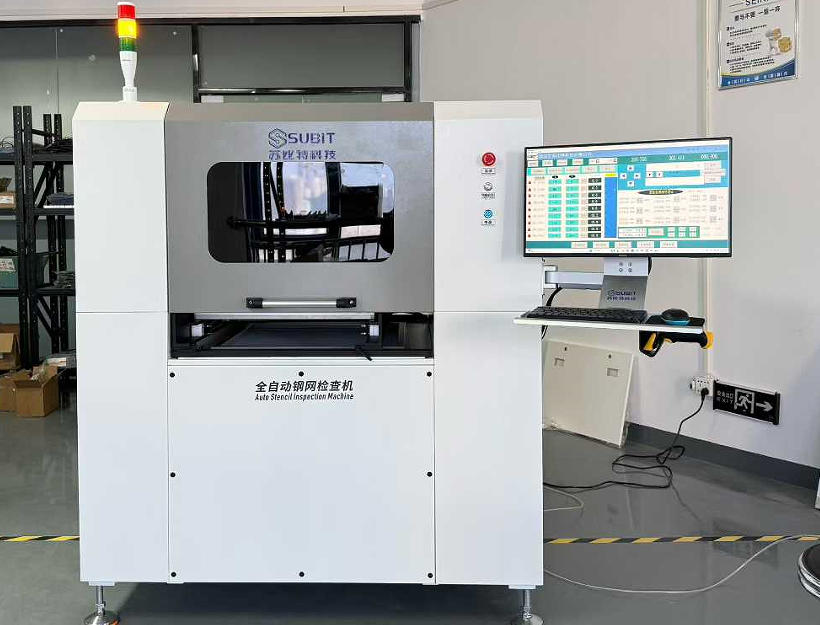
Key capabilities that close the quality loop:
QR‑code stencil identification for fast, error‑free template recall
Inspection history tracking across every stencil’s entire lifecycle
Cleaning cycle management based on actual contamination, not fixed schedules
Automatic report generation with standard and NG image archiving
Full MES integration for end‑to‑end traceability
Every inspection result becomes part of a digital quality record. Over time, you can correlate stencil condition with print yield, optimize cleaning intervals, and retire stencils before they cause defects. This transforms stencil management from reactive maintenance into predictive process control.
Technical highlights:
Detects clogged apertures, foreign objects, residues, burrs and damage
Multi‑position tension testing with ±1 N/cm² accuracy (0–60 N range)
±10 μm repeatability; minimum inspectable aperture 60 μm × 60 μm
1 second per FOV inspection speed for high‑frequency in‑line checks
Stainless steel frame, servo‑PLC drive system, industrial PC platform
Designed for daily, high‑frequency use after cleaning, before line changes and prior to storage, the SBT‑JC1009SA fits directly into your existing “use → clean → inspect → store → reuse” workflow.
Take Control of Your Print Yield
If 50–70% of your defects start at printing, improving stencil oversight is one of the highest‑ROI quality investments you can make. Instead of chasing defects after they appear, you eliminate them at the source.
Want to see how automated stencil inspection would perform on your production data? Reach out to the SUBIT engineering team for a tailored process assessment and quotation — we typically respond within 8 business hours.
Shenzhen SUBIT Technology Co., Ltd. — SMT stencil inspection and process control solutions for modern electronics manufacturing.
Previous: 7 Common Screen Stretching Machine Problems and How to Fix Them Next: no more


