



News Center
How to Choose an Automatic Stencil Inspection Machine for SMT
 2026-10-21
 106
Most SMT factories do not need a machine that re-verifies whether a stencil was manufactured correctly. They need one that answers a more practical question: is this used stencil still safe to put back on the line?
That single distinction should drive your entire buying decision. Here is a practical selection framework based on real SMT floor use—not brochure claims.
1. First, confirm what you are actually inspecting
There are two very different tasks. A stencil manufacturer or incoming QA team needs to compare a new stencil against Gerber data. An SMT factory managing daily stencil use needs to check whether a stencil remains serviceable after production, cleaning, handling, and storage.
If your focus is daily process control, your real risks are clogged apertures, residual paste, foreign objects, burrs, cleanliness, and tension loss—not whether the aperture was originally cut to the correct size. A Gerber-based system can do this, but you pay for file-parsing complexity you will rarely use.
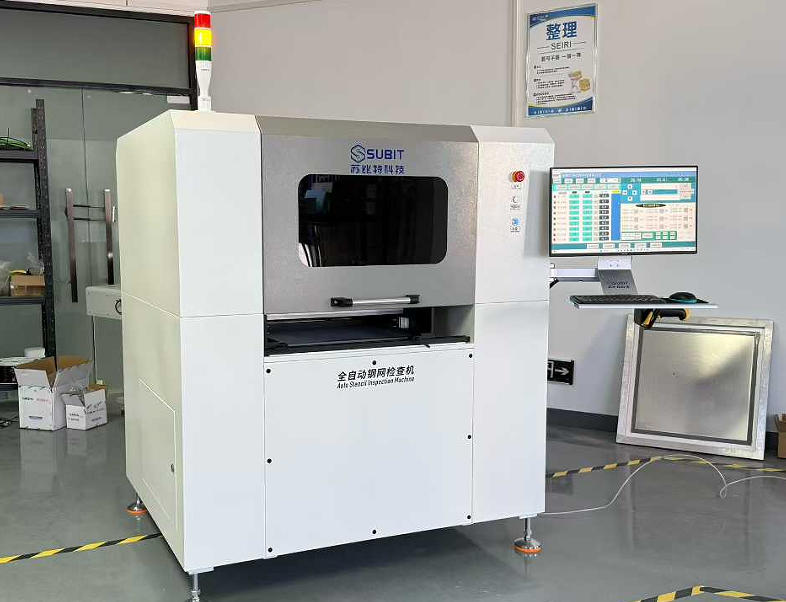
This is also where you need to be clear: the SBT-JC1009SA is designed for used stencil condition inspection, not new stencil qualification. It builds a standard template from a stencil that has already passed incoming inspection, then compares the stencil against that known-good physical reference. No Gerber import is required on the SMT floor.
2. Check the detection floor, not the resolution headline
Every supplier claims high accuracy. The only spec that matters for stencil work is the minimum detectable defect size. Look for inspection capability at or below 60 μm × 60 μm for aperture-level defects. Anything coarser will miss the partial blockages and thin residues that cause insufficient solder and tombstoning.
Also ask about repeatability, not just accuracy. A system that measures differently every time creates data you cannot trend. ±10 μm repeatability is a practical threshold for process control. Speed should support high-frequency checks—roughly 1 second per field of view is realistic for post-cleaning verification and pre-line-change confirmation.
3. Do not treat tension as a nice-to-have
Tension loss is one of the quiet killers of print quality. A stencil can look clean and still print poorly because the foil no longer responds consistently to squeegee pressure. Look for multi-point tension testing with ±1 N/cm² accuracy and a 0–60 N range, which covers the working range of most SMT stencils. Combining aperture inspection and tension measurement in one cycle gives you a condition snapshot, not just a hole check.
4. The software is where the real return lives
A stencil inspection machine without a traceability layer is just a faster pair of eyes. Ask four questions before you commit.
Can the machine identify the stencil without manual entry? QR-code-based stencil ID removes operator error and ties every result to a specific physical asset. Does it keep a searchable inspection history per stencil, so you can see when it was last checked and whether its condition is trending in the wrong direction? Can it manage cleaning cycles and flag when a stencil is due for verification? And does it generate reports automatically and upload data to your MES?
When these pieces are in place, every inspection result becomes part of a digital quality record. That enables full traceability across the stencil lifecycle and moves stencil management from reactive maintenance into predictive process control. The SBT-JC1009SA covers QR-based identification, inspection history tracking, cleaning cycle management, automatic report generation, and MES integration as part of its standard software scope.
5. Match the machine to your floor and your uptime needs
Confirm frame compatibility before anything else. A system rated for frames up to 736 × 736 mm with an inspection range of 600 × 600 mm covers most SMT production stencils without forcing a line layout change. Check the build too: a stainless steel weld frame with servo and PLC drive is made for a factory environment, not a lab. Standard single-phase AC 220V and 0.8 MPa air supply keep installation simple.
Finally, read the service terms. A 12-month whole-machine warranty, lifelong software upgrades, and a defined technical response window are part of cost of ownership, not extras.
The bottom line
A useful automatic stencil inspection machine for SMT is not the one with the longest feature list. It is the one that tells you quickly and objectively whether a used stencil is still fit for production—and records that judgment in a way your team can act on.
If your goal is post-cleaning verification, pre-line-change confidence, and closed-loop stencil management, the SBT-JC1009SA from Shenzhen SUBIT is built around exactly that scope. It is not a new-stencil qualification system; it is a daily condition-control tool for stencils already in use.
Not sure whether your current stencil inspection process is reactive or predictive? Send us a sample stencil or describe your bottleneck—we will give you a straight answer on whether this machine fits your line.
Previous: Stop Wasting Mesh: How a Precision Screen Stretching Machine Cuts Your Waste by 30% Next: How to Choose an LED Screen Exposure Machine: 8 Specs That Actually Affect Your Production Yield


