



News Center
Why Stencil Tension Loss Is the Silent Killer of SMT Print Yield
 2026-10-19
 109
Ask any SMT process engineer where defects come from, and the answer is predictable: the printing stage. Roughly 70% of assembly defects trace back to solder paste printing. Ask them what they are monitoring on the printer, and you will hear about squeegee pressure, speed, separation velocity, paste viscosity. Stencil tension rarely makes the daily checklist. That is precisely what makes it dangerous.
Stencil tension is not a “set it and forget it” parameter. It degrades continuously through use, cleaning, and handling. When it drops, the symptoms are not dramatic at first. A slight increase in bridging here, a few insufficient-paste calls there, a faint misregistration trend that everyone blames on the printer or the paste. By the time the root cause is identified, the line has already produced scrap, and the stencil may have been wrongly condemned—or worse, kept in rotation because it “still looks fine” to the naked eye.
This is the silent killer pattern: slow, cumulative, and invisible without measurement.
How tension quietly disappears
Tension loss is baked into the physics and chemistry of stencil use.
Cleaning is a major accelerant. Mesh-mounted stencils rely on epoxy adhesive to bond the foil to the frame. Every wash cycle exposes that bond to solvent and heat. Aggressive chemistry attacks the adhesive; elevated drying temperatures create differential thermal expansion between foil, mesh, and frame. The stencil does not fail suddenly—it relaxes. Foil tension drops by small increments, wash after wash.
Squeegee pressure contributes directly. Higher pressure improves aperture filling on the front end, but it also works against the foil. Over time, the combination of pressure, abrasion, and repeated deflection reduces foil tension, which then undermines gasketing and print definition. The process becomes self-defeating: the printer settings that mask tension loss in the short term accelerate it in the long term.
Mechanical fatigue is unavoidable. A stencil that has seen 5,000 to 10,000 print cycles has experienced that many tension–release cycles. The foil and mesh do not return perfectly to their original state. Tension decays as a function of use, not calendar age.
What a loose stencil actually does to the print
The failure mechanism is mechanical and easy to visualize. During printing, the stencil and PCB must behave as a sealed sandwich. When tension is uniform and sufficient, the foil snaps back cleanly after the squeegee passes, leaving a well-defined paste deposit.
When tension has diminished in one area—or across the whole foil—the stencil no longer stays flat against the board during the print stroke. The foil is pushed ahead of the squeegee, causing the aperture pattern to shift relative to the pads. Gasketing degrades. Paste bleeds under the stencil edges, creating the conditions for bridging, solder balls, and inconsistent deposit volumes. In fine-pitch areas, where hundreds of tiny apertures are trying to hold paste while the foil is being pulled downward during separation, a baggy stencil produces an uncontrolled release: some apertures release cleanly, others smear or leave paste behind.
These are not exotic defect modes. They are the everyday yield limiters that teams chase through paste adjustments and printer parameter tweaks—while the stencil itself is the variable that actually moved.
The standard is clear. The compliance gap is not.
Industry guidance is consistent. For stencils in active use, tension should generally remain at or above 35 N/cm, with fine-pitch applications calling for 40 N/cm or higher; below 30 N/cm, the stencil is a candidate for retirement. Some high-reliability operations set internal triggers at 25 N/cm for immediate removal.
The problem is not knowing the number. It is knowing which stencil is at what number, right now, and what it was last week.
Without a measurement record, tension is an opinion. A technician checks five points with a handheld gauge, writes a number on a paper traveler, and the stencil goes back to the rack. There is no link between that reading and the stencil’s cleaning history, its print count, or the defect trend on the line. When a tension reading drifts downward, there is no baseline to prove it, and no trigger to act before the next production run.
From reactive checks to a digital quality record
This is where the inspection step has to change—not by measuring tension more often in isolation, but by making every measurement part of a traceable record.
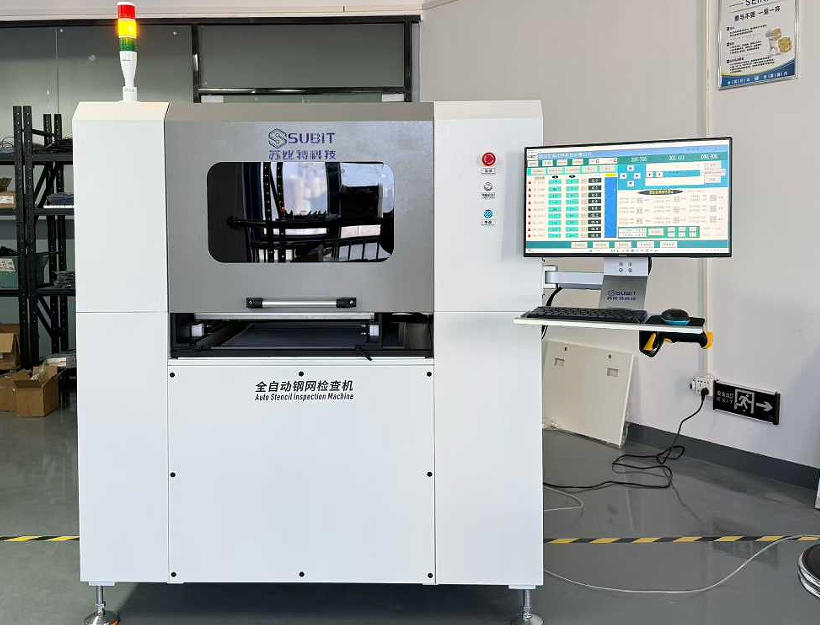
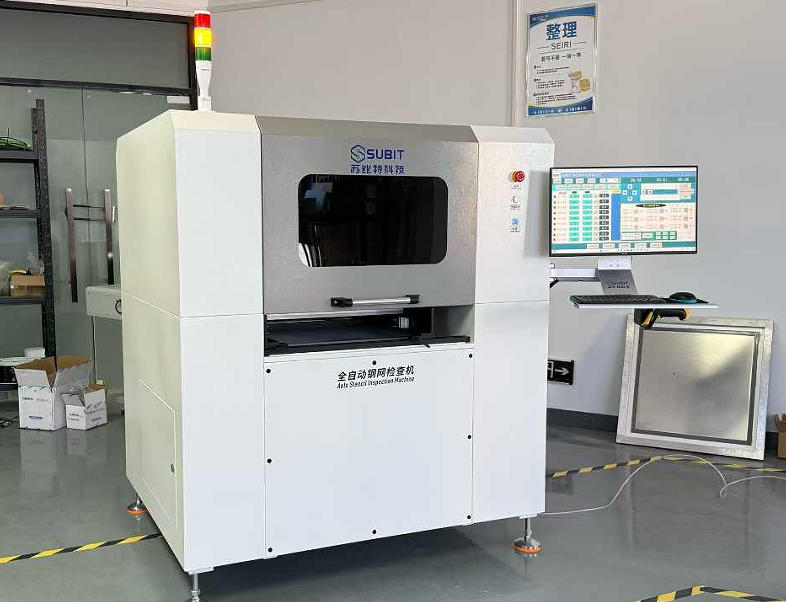
The SBT-JC1009SA from Shenzhen SUBIT is built around that principle. It is an offline automatic stencil inspection machine designed specifically for used stencils after cleaning and handling—it does not cover new-stencil verification. Its job is to answer one operational question with data: is this stencil still fit for continued use?
The machine combines multi-point tension measurement (±1 N/cm² accuracy, 0–60 N range) with optical inspection for aperture blockage, foreign objects, and residue. But the decisive capability is what happens to the results. Each stencil carries a QR code identifier. Every inspection—tension values, image capture, pass/fail determination—is written into a searchable digital record. Cleaning cycles are logged. Inspection history is linked to the stencil, not to a spreadsheet. MES connectivity pushes the data into the factory’s quality system, and reports generate automatically.
What that creates is not just a faster check. It creates a tension trend line per stencil. A reading of 38 N/cm means little in isolation. A reading of 38 N/cm on a stencil that measured 45 N/cm ten cleans ago, with a known print-cycle count and a known solvent exposure history, is a predictive signal. The stencil is on a trajectory toward the retirement threshold. Maintenance can be scheduled. The stencil can be pulled before it contributes to a defect event. That is the shift from reactive maintenance to predictive process control—using the stencil’s own lifecycle data to decide when intervention is cheaper than failure.
The yield you protect is the yield you can prove
Stencil tension loss will never announce itself on the line. It will not trigger an alarm. It will simply make the printing process slightly less capable, one clean at a time, until the defect rate crosses a line that demands investigation.
The manufacturers who close that gap are not the ones measuring tension more aggressively with a handheld gauge. They are the ones who treat every stencil as an asset with a measurable lifecycle—and who have the digital infrastructure to see the trend before the scrap does.
If your SMT line is still managing stencil condition on paper travelers and operator judgment, talk to SUBIT about what a traceable inspection workflow looks like on your floor. The SBT-JC1009SA is ready to show you where your stencils actually stand.
Previous: SMT First Article Inspection Machine Buying Guide: 5 Critical Factors Before You Invest Next: Eco-Friendly SMT Stencil Cleaning Machine: Cut Defects, Chemical Costs & ESG Risk


