



News Center
Stencil Inspection Machine Price Guide: What Drives Cost from $5,000 to $80,000
 2026-10-14
 110
110
If you are evaluating an automatic stencil inspection machine for your SMT line, the first question is almost always about price. Quotes can range from around $5,000 for a basic manual-assisted setup to over $80,000 for a fully automated system with MES integration.
That is a huge gap. The difference is not just “brand premium” — it comes down to five technical cost drivers that directly affect inspection accuracy, data traceability, and long-term production quality.
This guide breaks down what actually drives the cost, so you can match the right configuration to your production reality.
1. Optical System: The Single Largest Cost Driver
The camera and lens assembly typically accounts for 30–40% of the total machine cost. This is where the first major price tier emerges.
Entry-level machines ($5,000–$15,000) often use 2–5 megapixel sensors with standard lenses. They can catch gross defects like large blocked apertures or obvious foreign objects, but struggle with micron-level deviations.
Mid-range systems ($25,000–$50,000) move to 10–20 megapixel industrial cameras with telecentric or high-resolution lenses. This enables reliable detection of burrs, partial blockages, and aperture wall conditions down to 80μm x 80μm.
High-end configurations ($60,000+) add line-scan imaging capability for full-stencil coverage at higher throughput, plus multi-angle LED illumination to handle reflective solder paste residue and surface contamination that single-angle lighting misses.
Practical takeaway: If your stencil apertures are mostly above 150μm and your defect tolerance is moderate, a mid-range optical system is sufficient. If you run fine-pitch components (0201, 01005) or have strict SPI pass-rate requirements, the optical investment pays back through reduced false calls and escapes.
2. Tension Testing: From Optional to Integral
Tension measurement separates a basic optical comparator from a true stencil quality management system. This is the second major price differentiator.
Low-cost machines often rely on a separate handheld tensiometer operated manually. The data is recorded on paper or a spreadsheet — useful for spot checks, but not for process control.
Machines in the $30,000+ range integrate an automated tension tester with multi-position measurement (typically 5-point or 9-point testing across the stencil frame). Accuracy of ±1N within a 0–50N range allows you to track tension degradation over cleaning cycles and predict when a stencil should be retired before it causes print defects.
The cost is not just the sensor. It is the precision motion system, calibration, and the software logic that correlates tension data with cleaning history and print quality outcomes.
3. Software and Data Management: Where the Real Value Lives
A hard truth in SMT equipment pricing: two machines with nearly identical hardware specs can differ by $20,000–$30,000 based purely on software capability.
Basic software tier (sub-$20,000): Captures images, performs pass/fail comparison against a reference, generates a local report. The operator manually decides what to do next.
Intelligent data management tier ($35,000+): This is where the cost justifies itself over time.
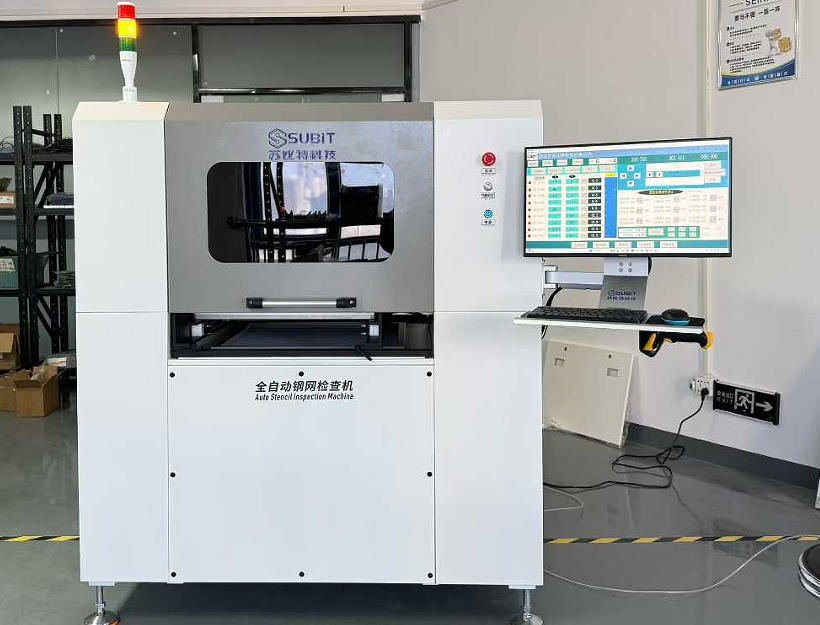
Our SUBIT SBT-JC1009SA is built around this principle. Every inspection result becomes part of a digital quality record. The system provides:
QR code-based stencil identification — scan a stencil, instantly retrieve its full lifecycle history
Inspection history tracking — how many cleaning cycles, what defects appeared, when tension started drifting
Cleaning cycle management — correlates cleaning performance with stencil condition
Automatic report generation — no manual data entry, no lost records
MES integration — pushes data directly into your production management system
This transforms stencil management from reactive maintenance into predictive process control. You stop replacing stencils on a fixed schedule and start replacing them based on actual condition data.
The software cost is not just development. It is the engineering effort to make the system compatible with your existing MES, to ensure data integrity across shifts, and to provide meaningful analytics rather than raw data dumps.
4. Mechanical Frame and Motion System
This is the “invisible” cost that separates machines that run reliably for a decade from those that develop positioning drift after two years.
Granite platforms, precision linear guides, servo motors with closed-loop control, and linear encoders add significant BOM cost. But they directly determine repeatability accuracy — typically expressed as 3–8% position accuracy in mid-range systems, tightening to under 3% in premium configurations.
A stencil inspection machine that drifts out of calibration every few months is not saving money. It is generating false rejects and eroding operator trust in the system.
5. Brand, Service, and Regional Factors
A machine assembled in Shenzhen and sold directly from the manufacturer typically costs 20–35% less than an equivalent system from a European or Japanese brand with a regional distributor network.
However, service capability matters. Key questions to ask:
Is technical support available in your time zone?
What is the response time for critical issues?
Are software updates included, or charged annually?
Is on-site installation and training provided?
A $40,000 machine with 7x24 support and free lifetime software upgrades may deliver lower total cost of ownership than a $30,000 machine with limited post-sale support.
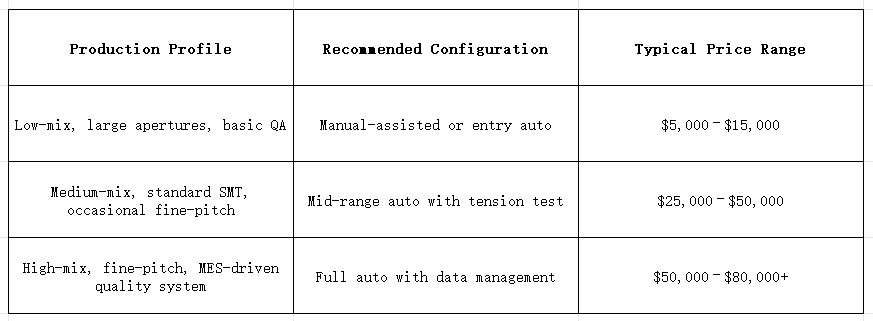
How to Match Budget to Production Reality
The Bottom Line
Stencil inspection machine pricing is not arbitrary. The cost tracks directly with optical resolution, automation level, data integration capability, and mechanical reliability.
If your goal is simply “check that the stencil looks OK,” a lower-cost machine may suffice. If your goal is to eliminate stencil-driven print defects, build a traceable quality record, and connect stencil management to your MES, the investment in the intelligent tier pays back through reduced scrap, fewer line stoppages, and data you can actually act on.
Ready to see what data-driven stencil management looks like in practice?
Contact our team for a live demonstration of the SBT-JC1009SA and a configuration recommendation based on your specific production requirements.
Previous: What Wavelength Do You Actually Need? 405nm vs 365nm LED Exposure Units for Different Emulsion Types Next: no more


