



News Center
Why 60–70% of SMT Defects Start at the Stencil — And How Automated Inspection Breaks the Cycle
 2026-09-30
 109
109
In the world of Surface Mount Technology (SMT), engineers spend hours tweaking reflow profiles and perfecting pick-and-place accuracy. Yet, industry data consistently shows that 60% to 70% of all SMT assembly defects originate at the solder paste printing stage.
When defects like bridging, insufficient solder, or solder balls appear, the root cause is often traced back to the stencil.
As a leading SMT equipment manufacturer, Shenzhen Subit has observed a common industry bottleneck: the reliance on manual, subjective stencil inspection.
The Limits of Traditional Manual Inspection
Historically, stencil inspection has been a manual, visual process. An operator holds the stencil under a light to check for clogged apertures or look for visible damage.
This traditional method has critical flaws:
No Data Traceability: It leaves no objective data records.
High Human Error: It cannot accurately measure tension or detect micro-deviations in aperture quality.
Reactive Maintenance: You only discover a bad stencil after a batch of defective PCBs has been printed.
Without accurate historical data, process engineers cannot accurately research how different stencil cleaning cycles affect print quality over time. This turns stencil management into a reactive guessing game rather than a controlled process.
Breaking the Cycle: The Shift to Automated Stencil Inspection
To break this cycle, SMT lines need to move from subjective human judgment to objective, quantitative data. This is where automated stencil inspection equipment steps in.
By utilizing high-precision optical measurement technology and automatic image recognition, modern systems automatically compare cleaned stencils against a standard reference image. They detect issues like blocking holes, foreign bodies, tension loss, and glitches with micron-level accuracy.
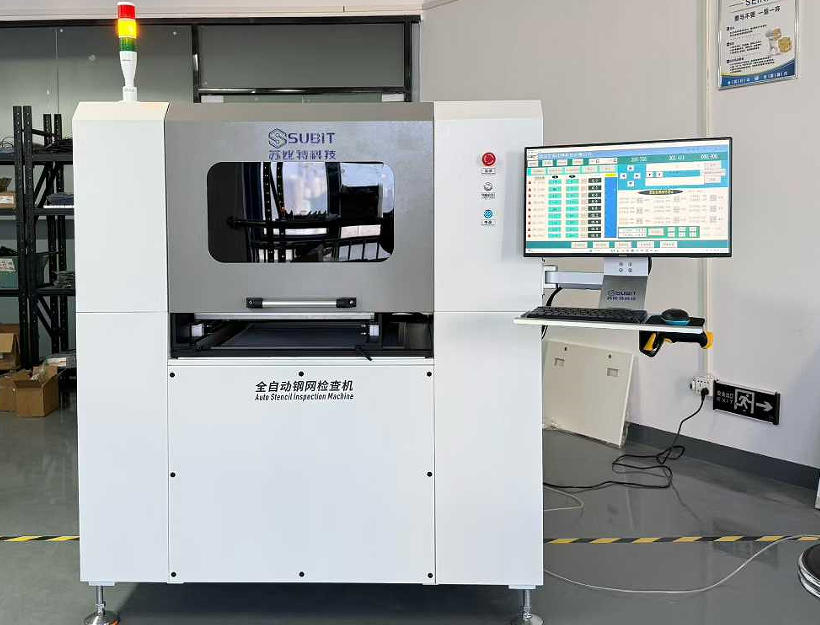
How Shenzhen Subit’s SBT-JC1009SA Transforms Stencil Management
At Shenzhen Subit, we designed the SBT-JC1009SA Automatic Stencil Inspection Machine to not just inspect, but to fundamentally upgrade your SMT process control.
Here is how our technology turns a quality bottleneck into a predictive advantage:
Objective Accuracy: Equipped with a 20-million-pixel camera and high-accuracy tension meter (±1N/CM2), it eliminates human judgment factors, providing direct, quantitative data in just 1 second per field of view(160X120MM).
Complete Digital Traceability: Every inspection result becomes part of a digital quality record. By utilizing QR code-based stencil identification, the system tracks every stencil's unique history, cleaning cycles, and tension changes.
Automated Reporting & MES Integration: The SBT-JC1009SA automatically generates detailed inspection reports and integrates seamlessly with your MES (Manufacturing Execution System). This provides complete traceability across the stencil lifecycle.
Predictive Process Control: By tracking inspection history and monitoring stencil accuracy changes, you can discover quality problems in advance. This prevents batch process problems caused by stencil wear, ultimately improving your SPI (Solder Paste Inspection) pass rate.
The Bottom Line for SMT Manufacturers
Automated stencil inspection is not just about finding broken stencils; it’s about gathering the data needed to improve your stencil opening process and solve printing machine problems before they occur.
By transforming stencil management from reactive maintenance into predictive process control, you protect your yield, reduce downtime, and ensure consistent quality.
Ready to break the defect cycle and upgrade to smart stencil management?
Discover how the Subit SBT-JC1009SA can integrate into your production line. Contact our team today for a machine demo and process consultation. Let's improve your SMT quality together.
Previous: How to Eliminate Bubbles in High-Viscosity Materials: A Practical Guide for Production Engineers Next: no more


