



News Center
Laboratory Powder Mixing Machine Selection Guide : 5 Mistakes That Ruin Your R&D Batches
 2026-09-12
 110
110
If your lab batches show inconsistent homogeneity despite careful formulation, the mixer — not the formula — is often the culprit. After a decade of supplying precision mixing equipment to pharma, electronics, and materials labs, we at Shenzhen Subit have seen the same selection errors repeated across R&D facilities. This guide covers the five most common mistakes and how to avoid them.
Mistake 1: Filling the Vessel Too Full
The most frequent cause of poor blend uniformity is overloading. Laboratory tumble blenders (V-blenders, double-cone mixers) rely on gravity-driven diffusion. If the vessel is filled above 50–60% of total volume, the powder bed cannot cascade properly, and dead zones form at the bottom of the V.
Rule of thumb: For a 10L V-blender, your working batch should not exceed 5–6L. For dense or cohesive powders, stay closer to 40%.
Mistake 2: Choosing the Wrong Mixing Principle for Your Material
Not all lab powders behave the same way. V-blenders excel with free-flowing, fragile materials — they produce minimal particle degradation. But if your powder is cohesive or has significant density differences between components, a V-blender will segregate rather than mix.
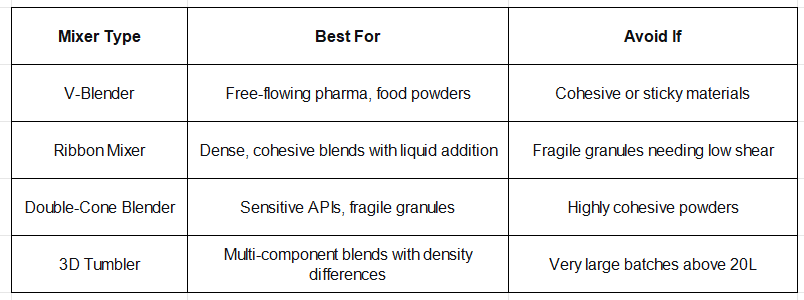
If you are blending metal powders with ceramics, or API with excipients at low ratios, a 3D motion mixer outperforms conventional V-blenders because the compound motion reduces stratification.
Mistake 3: Ignoring RPM and Time Programmability
A fixed-speed mixer forces you to accept whatever homogeneity it delivers. Material properties vary batch to batch — humidity, particle size distribution, and electrostatic charge all affect mixing kinetics. Without adjustable speed and timed programs, you cannot optimize for each formulation.
Look for equipment with digital control, at least 5–10 programmable segments, and rpm ranges starting as low as 5 rpm for gentle blending and up to 80 rpm for faster homogenization.
Mistake 4: Overlooking Material of Construction and Sealing
Stainless steel 304 is standard, but if you work with active pharmaceutical ingredients or metal-sensitive powders, 316L or PTFE-lined vessels are necessary to prevent contamination and corrosion. Sealing matters too: poor seals allow moisture ingress and cross-batch contamination, especially in humid environments like Shenzhen and coastal manufacturing hubs.
Mistake 5: Scaling Directly from a 2L Trial to a 200L Production Run
Lab mixers are not just “small versions” of production units. A formulation that blends perfectly in a 2L V-shell may fail at 200L if the mixer geometry, fill ratio, and shear profile differ. The fix: choose lab equipment with scalable mixing kinematics — same motion principle, same fill-ratio logic. This is why we design Subit lab mixers to mirror the mixing dynamics of larger planetary centrifugal and tumble systems, so your R&D data translates reliably to pilot and production scales.
A Quick Uniformity Check
Before committing to a mixer, run a simple sampling test. After blending, withdraw samples from three positions — top, middle, and discharge point — and measure RSD (relative standard deviation) for your key component. For most pharmaceutical and specialty chemical applications, RSD below 5% is the target. If your current equipment cannot reach that, the mixer is limiting your formulation quality.
Why Labs Choose Subit
Shenzhen Subit Technology has manufactured precision mixing and defoaming equipment since 2014. Our planetary vacuum defoaming mixers handle powders, pastes, and high-viscosity materials with rotation-revolution compound motion up to 2500 rpm, achieving uniform dispersion without blades or shear damage. For dry powder blending, we offer lab-scale tumble and 3D mixers with programmable speed/time control, 304/316L stainless steel construction, and GMP-compatible sealing.
Every unit ships with documentation suitable for GxP environments, and we provide process consultation — send us your material specs, typical batch size, and homogeneity target, and we will recommend the right configuration.
Ready to solve your blending bottleneck?
Contact Subit Engineering →
Tell us: material type, batch size, and required RSD. We reply within 24 hours.
Previous: How to Cut First Article Inspection Time by 80%: A Practical Guide for SMT & PCB Manufacturers Next: UV LED Exposure Unit for Screen Printing: How to Cut Exposure Costs by 80% and Speed Up Production


