



News Center
Why SMT First Article Inspection (FAI) Is the Most Critical Quality Gate Before Mass Production
 2026-08-15
 191
191
In Surface Mount Technology (SMT) assembly, the difference between a smooth production run and a costly disaster often comes down to one moment: the inspection of the first assembled board. First Article Inspection (FAI) is the verification gate that determines whether your line is ready for volume production or heading toward a cascade of defects.
What Makes FAI So Critical?
When the first assembled board is approved, it authorizes the entire production line to continue with all the assumptions embedded in your BOM, CAD placement data, feeder setup, and component polarity logic. If any of those assumptions are wrong, the error doesn’t stay local—it repeats across hundreds or thousands of boards.
Traditional manual FAI methods are time-consuming, error-prone, and increasingly inadequate for today's high-mix, high-density PCB assemblies. That’s where intelligent first article detection systems come in.
What an Intelligent FAI System Delivers
A modern SMT first article detector transforms the inspection process from a manual bottleneck into a streamlined, automated quality gate. Here's what the right system should offer:
1. Comprehensive Circuit Board Coverage
The system should support all common SMT furnace-front board types—solder paste boards, pertinax (double-sided adhesive) boards, and red rubber boards. Whether you're running consumer electronics or automotive PCBs, the equipment should handle the full range without requiring board-size restrictions.
2. High-Precision LCR Measurement
Instead of relying on multimeters, intelligent FAI systems integrate a high-precision LCR electric bridge. Key specifications to look for:
Test frequency: 50Hz to 100KHz
Basic precision: 0.05%
Measurement range: Resistance from 0.01mΩ to 99.9999MΩ; Capacitance from 0.00001pF to 9.9999F; Inductance from 0.01nH to 9999.9H
Automatic range selection: The test software automatically controls and selects the appropriate measuring gear and parameters
This level of precision ensures that resistors, capacitors, and inductances are measured accurately, while diodes can be polarity-distinguished and LEDs can be lit up for verification.
3. Intelligent Programming Mode
The days of manual BOM cross-referencing are over. An advanced FAI system should offer:
One-key import: Quickly import BOM tables and XY coordinates, automatically matching with the bit map
Automatic specification extraction: Extract component specifications directly from material descriptions
Double-side support: Import double-side coordinates and detect one side at a time
Blank position identification: Automatically identify and label blank positions on the board
4. Comprehensive Defect Detection
A robust FAI system catches errors across two critical dimensions:
Data-level errors: Wrong consumption of BOM, repetitive positions, missing definitions or over-definitions of XY coordinates
Board-level errors: More pastes, missing parts, wrong parts, reverse polarity, flip-over, offset, or rotation
5. Full Traceability with SPC Control
Quality isn't just about catching defects—it's about proving you caught them. The system should record all test data throughout the entire process and export statements in both Excel and PDF formats. This enables later-stage scenario restoration and provides a solid traceability foundation for customer audits.
6. Centralized Data Management
For multi-line factories, server mode with a central database enables centralized and unified management of all FAI data. This is essential for maintaining consistency across production lines and meeting the traceability requirements of automotive, aerospace, and medical device manufacturers.
7. User-Friendly Operation
With a 23.8" liquid crystal display and clear OK/NG audible and visual prompts, operators can quickly identify pass or fail conditions. The average detection speed of 3 seconds per component means one operator can efficiently handle the inspection workload that previously required multiple staff members.
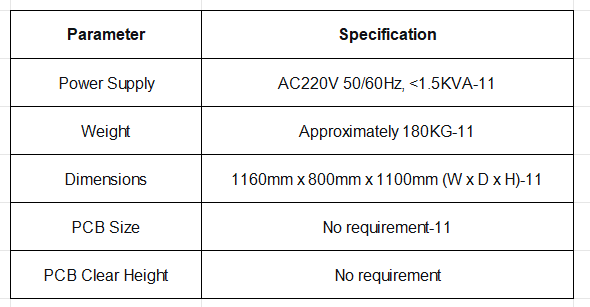
Technical Specifications at a Glance
The Bottom Line
First Article Inspection is not an optional extra—it is the release point that protects your entire production run. Investing in an intelligent SMT first article detection system means catching errors before they scale, reducing rework costs, maintaining production schedules, and delivering consistent quality to your customers.
For electronics manufacturers looking to stay competitive in today's demanding market, an automated FAI system isn't just a quality tool—it's a strategic necessity.
Previous: Why LED Energy Saving Screen Exposure Machines Are Revolutionizing the Printing Industry Next: SMT Stencil Cleaning Done Right: Eco‑Friendly, Automated, and Built for Zero Waste


