



News Center
How Automatic Stencil Inspection Machines Eliminate 70% of SMT Printing Defects
 2026-08-07
 190
190
In the world of Surface Mount Technology (SMT), one statistic has become almost legendary: up to 70% of all PCB assembly defects originate during the solder paste printing stage. Industry research consistently confirms that 60% to 75% of board assembly problems stem from the printing process. The stencil—the master mold for solder paste deposition—is the silent workhorse that determines success or failure. If the stencil is flawed, every subsequent board printed carries that defect forward.
Yet for years, manufacturers have relied on manual visual checks and basic tension gauges to qualify these critical tools. As component geometries shrink and board densities explode, manual inspection has become an obsolete bottleneck.
The Hidden Crisis: Why Manual Inspection Fails
A typical SMT line might inspect a new stencil upon arrival with a quick visual check. During production, operators wipe the stencil and occasionally test tension with a handheld probe. This methodology is riddled with risks:Subjectivity and Human Error: The human eye cannot reliably detect micro-burrs inside an aperture or a 10-micron deviation in pad position.
Lack of Data Traceability: A manual tension test offers a snapshot in time—often written on a piece of paper. There is no way to trend the degradation of a stencil over its lifecycle.
The Cleaning Conundrum: A stencil is cleaned to remove paste. But is the cleaning process itself destructive? Aggressive chemicals or high-pressure washing can stretch the mesh or damage adhesive bonds. Without automated verification, a “clean” stencil might actually be a damaged one.
How Automatic Stencil Inspection Works
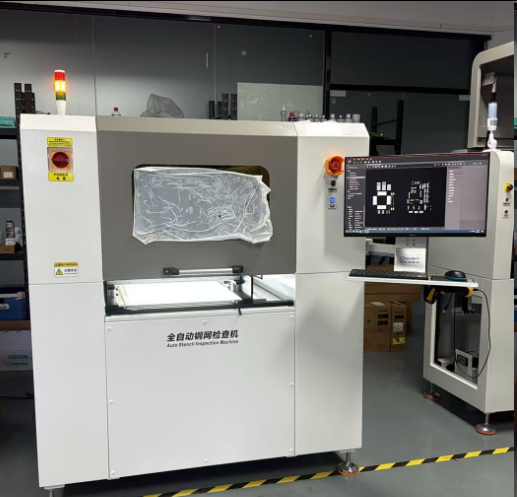
Modern automatic stencil inspection equipment replaces guesswork with high-resolution optical measurement and algorithmic comparison.A comprehensive inspection system covers multiple defect types:
Blocked holes – Apertures clogged with dried solder paste or debris
Foreign bodies – Contaminants trapped in apertures
Tension abnormalities – Mesh stretching or loosening that affects paste release
Burrs and glitches – Micro-defects in aperture walls
From 70% Defects to 70% Reduction
The math is compelling. If 70% of SMT defects originate at the printing stage, then eliminating print-stage defects eliminates the majority of downstream failures.
1. Catch Defects Before They Multiply
A single stencil defect—one blocked aperture, one micro-burr—can ruin hundreds of boards before an operator notices the pattern. Automatic inspection detects these issues immediately, preventing defective boards from entering the production flow.
2. Verify Cleaning Effectiveness
Stencil cleaning is essential, but it must be verified. An automatic inspection system confirms that all apertures are truly free of solder paste after cleaning, ensuring that cleaning processes are effective—not destructive.
3. Monitor Tension Throughout the Stencil Lifecycle
Tension is critical to paste release. As stencils are used and cleaned, mesh tension degrades. A high-accuracy tension test—with accuracy up to ±1N/cm and multi-position testing—provides objective, traceable data to determine when a stencil should be retired.
4. Eliminate Operator Variability
Manual inspection is inconsistent. One operator’s “pass” is another’s “fail.” Automatic systems provide repeatable accuracy of 3–8%, ensuring every stencil is evaluated against the same objective standard.
5. Enable Data-Driven Process Control
Modern inspection systems store template images and inspection data, enabling full traceability. Engineers can search clean times and inspection histories, trending stencil degradation over time and making informed decisions about cleaning cycles and replacement intervals.
The Bottom Line
Our SUBIT Automatic Template Detection System stands out as a cost-competitive solution in the current market landscape. For SMT manufacturing facilities, it represents an undeniably valuable investment.It is an absolute necessity for any factory striving for Six Sigma quality levels. By catching print-stage defects before they propagate, manufacturers can reduce screen printing rework rates by up to 70%, protect first-pass yield, and transform stencil management from a guessing game into a predictable, data-driven process.
The 70% rule has been proven in industry practice. The question is no longer whether to implement automatic stencil inspection—but how soon.
Previous: Screen Stretching Machine | Printing Equipment Manufacturer Next: Stretching Equipment – Screen Printing: The Foundation of Print Precision


