



News Center
Slash SMT Rework by 70%: The Business Case for Automatic Stencil Inspection
 2026-07-31
 177
177
In SMT assembly, the stencil is the gatekeeper of print quality. A single clogged aperture, a tiny burr, or a slight tension drop can cascade into opens, bridges, and costly rework. Yet for years, many factories relied on manual checks—slow, subjective, and unable to catch sub‑80µm defects.
Enter the Automatic Stencil Inspection Machine – a precision optical system that verifies stencil integrity before printing ever starts. This guide cuts through the noise and explains what it does, why it matters, and how to choose the right one for your line.
What Is Automatic Stencil Inspection?
An Automatic Stencil Inspection (ASI) machine is a dedicated inspection tool that scans SMT stencils for:
Aperture blockages (paste residue, dust, fibres)
Foreign objects (contaminants that transfer to PCBs)
Burrs and edge defects (cause paste smearing)
Tension degradation (affects flatness and print consistency)
Dimensional errors (missing or misaligned holes)
Unlike SPI (which checks paste after printing) or AOI (which inspects components), ASI focuses on the tool itself – upstream prevention at its best.
Why Manual Inspection Falls Short
Even experienced operators cannot reliably detect 80µm×80µm defects or measure tension with ±1N/cm accuracy. Fatigue, subjectivity, and lack of reference source make manual checks a weak link in quality control.
Automatic stencil inspection solves these pain points:
Repeatability – consistent results, independent of operator
Speed – full stencil inspection in minutes (0.7–0.9 s/FOV)
Traceability – automatic logs for SPC and audit compliance
Cost reduction – less rework, scrap, and labour dependency
How an Automatic Stencil Inspection Machine Works
1. High‑Resolution Imaging
A high‑megapixel camera (up to 20MP) paired with precision optics and uniform LED lighting (top + bottom) captures distortion‑free images over a wide FOV (e.g. 250×190 mm).
2. Intelligent Defect Detection
The system compares the stencil against a reference template(new verified qualified stencil) for post-cleaning&pre-printing verification. Advanced algorithms automatically flag:
Blocked or partially blocked holes
Foreign particles
Burrs and scratches
Shape and position deviations
3. Integrated Tension Testing
Built‑in high‑accuracy tension meters perform multi‑point measurements across the stencil surface, with precision of ±1 N/cm over a 0–60N range. This ensures the stencil maintains proper tension throughout its life.
Critical Specifications at a Glance
When evaluating an ASI machine, focus on these performance drivers:
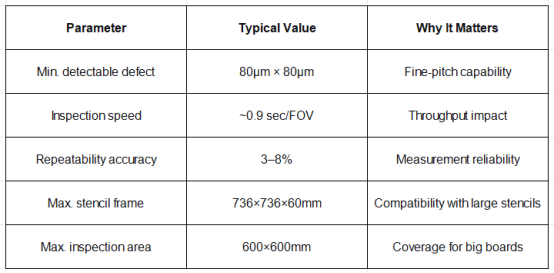
For the optical system, look for high‑resolution cameras, distortion‑free lenses, and adjustable white LED lighting. The drive system (servo motor + PLC) ensures precise, repeatable positioning.
ASI vs. SPI vs. AOI – Know the Difference
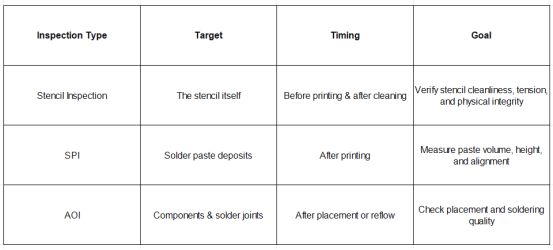
Stencil inspection is the first line of defence – stopping defects before paste even touches the board.
Who Benefits Most?
SMT assembly plants – want to monitor stencil condition over time, optimise cleaning cycles, and reduce printing defects.
The ROI of Going Automatic
Investing in an automatic stencil inspection machine delivers measurable returns:
Rework reduction – cutting screen‑printing rework by up to 70%
Labour savings – one machine replaces multiple manual inspectors
Extended stencil life – early detection prevents permanent damage
Process optimisation – trend data helps fine‑tune cleaning and printing parameters
Audit confidence – full traceability for ISO and customer requirements
How to Choose the Right Machine
Ask these questions before buying:
What’s your minimum aperture size? – Ensure the system can detect defects at your finest pitch (down to 30–40µm for advanced applications).
What’s your production volume? – Speed matters; look at FOV time and total inspection cycle.
What stencil sizes do you use? – Verify frame and inspection area support (736×736mm and 600×600mm are common standards).
Do you need file‑based inspection? –No need file, verified qualified new stencil from supplier can be as a reference template.
What software features are included? – User authority, QR code management, searchable history, and SPC dashboards add real value.
What about service and support? – Prefer 12‑month warranty, lifelong software upgrades, and 7×24 support with rapid response.
Also consider physical requirements: AC 220V±10%, ~2KW power, 0.8MPa air pressure, and a stable environment free from vibration that could affect accuracy.
Final Thoughts
The Automatic Stencil Inspection Machine is a strategic necessity for any SMT line that values yield, quality, and cost control. By replacing guesswork with precision, it empowers you to catch defects pre-printing, extend stencil life, and build a truly traceable quality system.
Previous: Stop Wasting Time on Bladed Mixers: How Planetary Centrifugal Mixers Cut Paste Prep Time by 90% Next: Why Your Lab Needs a 3D Powder Mixer


