



News Center
Eco‑Friendly SMT Stencil Cleaning: Boosting Yield & Sustainability in Precision Manufacturing
 2026-07-24
 179
179
Why Stencil Cleaning Directly Impacts Your Bottom Line
In SMT assembly, the stencil printing step determines up to 60% of final soldering quality. As components shrink to 01005 and 0.3‑mm pitch BGAs, even microscopic paste residue in apertures causes bridging, insufficient deposits, and solder balls — defects that drive up rework costs and erode first‑pass yield.
Beyond visible defects, ionic flux residues left on stencils can trigger electrochemical migration, leading to latent field failures in automotive or medical devices. And manually cleaning with IPA or acetone not only gives inconsistent results but also shortens stencil life by deforming aperture edges and reducing tension.
The solution? An automated, eco‑friendly stencil cleaning machine that delivers repeatable, precision cleaning while cutting environmental and operational costs.
What “Eco‑Friendly” Really Means for Stencil Cleaning
A genuinely green cleaning system goes beyond using water instead of solvents. Look for these core features:
Water‑based cleaning chemistry – non‑flammable, low‑VOC, and safe for operators, yet powerful enough to remove both rosin‑based and water‑soluble fluxes in one cycle.
Closed‑loop filtration – continuously recycles cleaning fluid, reducing chemical consumption by 40‑60% and virtually eliminating hazardous waste discharge.
Integrated wash‑rinse‑dry – completes all steps in a single chamber, saving floor space and energy compared to separate stations.
Low power draw – magnetic‑drive pumps and efficient heaters minimise electricity use, lowering your carbon footprint and utility bills.
Precision Advantages You Can’t Get with Manual Cleaning
Automated cleaning isn’t just “greener” — it’s more effective for fine‑pitch production:
Consistent, repeatable results – programmable parameters (spray pressure, time, temperature) remove operator variability, ensuring every stencil meets IPC‑5704 cleanliness standards.
Superior aperture cleaning – high‑pressure spray or ultrasonic action reaches into the tiniest openings, something cloth‑wipe methods simply cannot achieve.
Longer stencil life – gentle, controlled processes preserve stencil tension and surface integrity, so you replace stencils less frequently — a direct cost saving.
How to Choose the Right Machine for Your Line
When evaluating systems, prioritise these factors:
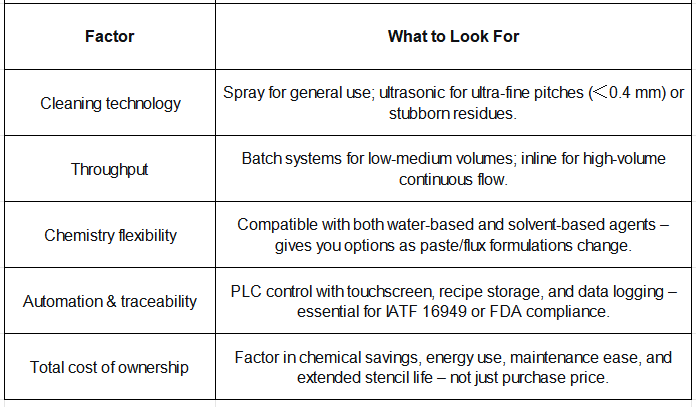
Most quality eco‑friendly systems achieve full ROI within 12‑18 months through reduced scrap, lower consumable usage, and labour savings.
Best Practices for Maximum Benefit
Set a cleaning schedule – every 5‑10 prints for standard pastes; more often for fine‑pitch; less often if using nano‑coated stencils.
Match chemistry to paste – water‑based cleaners work for the vast majority of modern no‑clean and water‑soluble fluxes.
Verify cleanliness – use ionic contamination testing or simple visual checks to confirm process effectiveness.
Perform regular maintenance – clean filters, check nozzles, and calibrate sensors to keep performance consistent.
The Bottom Line
An eco‑friendly SMT stencil cleaning machine is no longer a “nice‑to‑have” — it’s a competitive necessity. It directly improves print quality, reduces defects, extends stencil life, and helps you meet tightening environmental regulations — all while supporting your corporate sustainability goals.
In a world of miniaturised electronics and rising customer expectations, precision cleaning is the silent enabler of reliable, high‑yield production. Make the switch, and you’ll see the difference not just in your defect rate, but in your operational efficiency and brand reputation.
Previous: SMT Quick Tips: How to Select the Right Stencil Printer for Your Production Line Next: Automatic Stencil Inspection Machine: The Key to Zero-Defect SMT Printing


