


News Center
Automatic Emulsion Coater for Screen Printing Frames: The Key to Precision & Efficiency
 2026-07-15
 161
161
Why Manual Emulsion Coating Is Holding Your Shop Back
In many screen printing shops, the darkroom is the bottleneck. Manual coating is slow, physically demanding, and—most critically—inconsistent. One screen gets a thicker coat on the left side; another ends up with uneven stencil thickness across the mesh. These variations show up on press as inconsistent ink deposits, blotchy exposures, and wasted screens.
The reality is simple: you cannot achieve micron-level precision by hand. And in today’s competitive market, inconsistent stencils mean inconsistent profits.
What Is an Automatic Emulsion Coater?
An automatic emulsion coating machine is a purpose-built device that applies photosensitive emulsion onto screen mesh with programmed precision. Instead of relying on an operator’s arm speed, angle, and pressure, the machine controls every variable—coating speed, pressure, number of passes, and dwell time.
The result? Every screen is identical. Every time.
The Core Benefits of Automating Your Coating Process
1. Micron-Level Precision
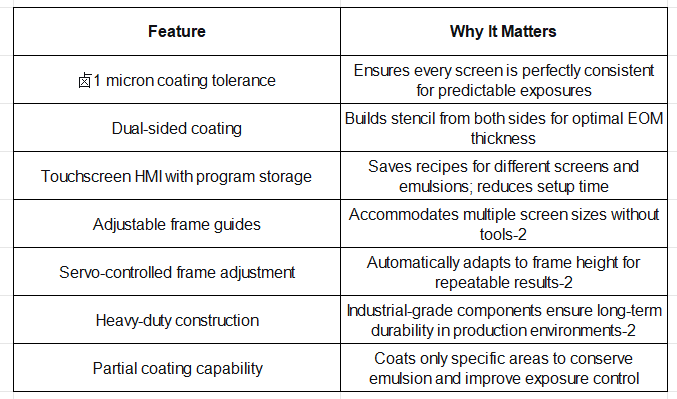
Modern automatic coaters achieve coating tolerances of ±1 micron. To put that in perspective, the average human hair is about 80 microns wide. An automatic coater gives you control 40 times finer than a human hair.
This level of precision is essential for high-resolution graphics, halftones, and computer-to-screen (CTS) workflows where stencil consistency directly determines print quality.
2. Dual-Sided Coating for Optimal Stencil Build
Quality automatic coaters coat both sides of the screen simultaneously. This ensures proper Emulsion Over Mesh (EOM) thickness—the critical factor that affects exposure accuracy, ink flow, and stencil durability on press.
3. Dramatically Reduced Labor Costs
Manual coating ties up skilled operators for hours. With an automatic coater, one operator can coat hundreds of screens per day while the rest of the team focuses on higher-value tasks. Labor costs drop, and productivity soars.
4. Eliminates Operator Fatigue and Error
Manual coating introduces variation—different operators, different techniques, different results. An automatic system removes the human variable entirely. What’s more, it’s much simpler to train new operators or substitute them when needed.
5. Programmable Recipes for Repeatability
Today’s automatic coaters feature touchscreen interfaces that store multiple coating programs. Different mesh counts, emulsions, and applications require different coating strategies. With programmable settings, you save the perfect recipe for each job and recall it instantly—no guesswork, no wasted screens.
Key Features to Look For in an Automatic Emulsion Coater
Applications Across Industries
Automatic emulsion coaters serve a wide range of industries:
Textile printing – T-shirts, apparel, and fabric designs
Electronics – PCB and circuit board manufacturing
Signage & graphics – Posters, banners, and decals
Industrial printing – Glass, ceramics, and automotive components
Solar photovoltaic – High-precision screen coating for solar cells
Is an Automatic Coater Right for Your Shop?
If you answer yes to any of these questions, it’s time to consider automation:
Are you spending hours each day manually coating screens?
Do you see variation in print quality from screen to screen?
Are you struggling to scale production without adding headcount?
Do you run high-resolution jobs that demand perfect stencil consistency?
Are you investing in CTS or other prepress technologies that require precise screens?
Making the Switch
Transitioning from manual to automatic coating is one of the highest-ROI investments a screen printing shop can make. The machine pays for itself through reduced waste, fewer remakes, lower labor costs, and higher-quality output that commands premium pricing.
When selecting an automatic emulsion coater, consider your maximum frame size, production volume, and the types of emulsions you use. Look for a machine that offers the precision, durability, and programmability your operation demands.
Previous: Stop Wasting Emulsion: How a Full Auto Touchscreen Exposure Unit Saves Time & Money Next: PCB Flying Probe First Article Inspection Machine


