



News Center
Screen Printing Machine Cost in 2026: What You’ll Really Pay (Full Breakdown)
 2026-07-12
 104
104
If you’re searching for a screen printing machine, the first number you see is rarely the whole story. Prices range from under $200 to over $100,000 – but the right answer for your business depends on volume, automation, and hidden costs.
This short guide gives you a clear, realistic view of what to budget, what drives price, and how to avoid overspending – whether you’re a startup or an expanding shop.
Quick Cost Snapshot
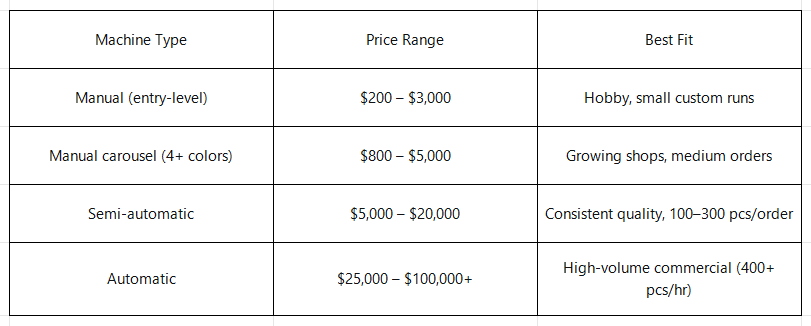
Note: These are press-only figures. Your total setup will be 30–40% higher once you add screens, inks, curing, and washout gear.
What Really Determines the Price?
Automation – manual is cheap because you do the work; automatic adds motors, pneumatics, and PLC controls.
Color count & stations – more heads = more cost. A 1‑color press is a few hundred; a 10‑color auto can exceed $100k.
Build & precision – servo drives, micro‑registration, and touchscreen controls raise price but improve repeatability.
Substrate – textile presses are more affordable; specialty machines for glass, metal, or electronics command premium prices.
Manual Presses – The Affordable Start
Perfect for learning, low‑volume orders, or tight budgets. A basic tabletop manual can be found for $200–$800; a 4‑color carousel runs $800–$5,000.
Pros: Low entry cost, complete hands‑on control.
Cons: Slow, physically tiring, inconsistent for large runs.
Who should buy: Hobbyists, startups testing the market, or shops with orders under 100 pieces.
Semi‑Automatic – The Sweet Spot
These machines automate the squeegee and flood stroke (pneumatic or electric), giving you consistent prints without full automation cost.
Price: $5,000 – $20,000, with some entry models starting around $1,000.
Pros: Better consistency, less fatigue, moderate investment.
Cons: Still manual loading/unloading – throughput caps around 300 pieces per order.
Who should buy: Growing businesses that need repeatable quality and are not yet ready for a $50k+ auto press.
Automatic – The Production Powerhouse
Fully automated pallet movement, print heads, and optional flash curing. These machines are built for speed and consistency, day after day.
Price: $25,000 – $40,000 for entry‑level; $40k–$60k for mid‑range; $60k–$100k+ for high‑end 8+ color systems. Specialty industrial units can reach $75k+.
Pros: 400+ shirts per hour, minimal labor per piece, uniform quality.
Cons: Requires industrial space, three‑phase power, large air supply, and regular maintenance.
Who should buy: Established shops with steady, high‑volume orders and the infrastructure to support it.
Total Setup Cost – Don’t Forget the Rest
Your press is only 60–70% of the budget. Reserve 30–40% for:
Screens, frames, squeegees, emulsion ($200–$600)
Inks (plastisol or water‑based) – $100–$300
Flash cure or conveyor dryer – $250–$2,000
Exposure unit – $200–$800
Washout booth – $200–$600
Software and computer – $0–$600
Complete startup estimates:
Hobby / small shop: $200 – $1,000 total
Commercial startup: $1,000 – $2,500
Growth‑ready shop: $3,000 – $6,000
Professional operation: $8,000 – $32,000+
Hidden Costs That Impact Your Bottom Line
Labor – manual presses need one operator per station; auto presses reduce per‑unit labor but require skilled technicians.
Consumables – ink, emulsion, chemicals, and mesh are recurring. For high volume, these add up fast.
Maintenance – auto machines have more moving parts; budget for spare parts, servicing, and occasional repairs.
Shipping & installation – heavy equipment, often professional setup required. Factor these into your initial cash outlay.
New vs. Used – What’s Smarter?
Used manual – safe bet if inspected; prices from $500–$5,000. Few moving parts, low risk.
Used automatic – starts around $25,000, but be cautious. Check print quality, listen for odd noises, test pneumatics and electronics. Always ask for a demo. Factor in refurbishment costs.
Pro tip: If you buy used, insist on a production test and verify registration accuracy across all heads.
Sourcing from China – Cost Advantage
Chinese‑made screen printing equipment can save you 20–35% compared to Western brands, without compromising quality when you choose the right supplier. Key manufacturing regions:
Guangdong (Shenzhen, Dongguan) – precision manual and semi‑auto systems.
Hebei – cost‑effective flatbed and cylindrical printers.
Zhejiang – compact systems with UV curing.
Shanghai – high‑end fully automated industrial lines.
What to look for: on‑time delivery >95%, reorder rate >15%, customization flexibility, and after‑sales technical support. Don’t just chase the lowest price – check capability and reputation.
Example Chinese market prices (FYI):
Entry manual garment press: ~$82
Manual bottle printer: ~$279
Semi‑auto: $900–$1,100
Compact auto: $1,000–$16,000
A Simple Framework to Choose Right
Ask yourself these 5 questions before buying:
Volume – under 100 pcs? Manual. 100–300? Semi‑auto. 400+? Auto.
Budget – include all accessories and consumables, not just the press.
Space – garage or spare room? Manual. Industrial unit with 3‑phase? Auto.
Substrate – T‑shirts vs. glass/electronics – different specs.
Growth – buy for where you’ll be in 2 years, but don’t over‑buy unused capacity.
ROI – When Will It Pay Back?
In optimal cases, payback can be as short as 3–6 months, but a more realistic timeline is 12–18 months for a growing shop. Key levers:
Lower per‑unit cost as volume grows.
Labor savings with automation.
Reduced waste from consistent quality.
Eliminating outsourcing costs (in‑house printing).
Final Takeaway
The cost of a screen printing machine is just the starting point. Match your investment to your real production needs, plan for the full ecosystem, and choose a supplier who offers reliable support – not just a low sticker price.
At Subit, we help printers of all levels find the right equipment for their business, from manual starters to high‑speed automatics. We focus on practical, value‑driven solutions tailored to your goals – no generic sales pitches.
Previous: Screen Printing Machine Cost in 2026: What You’ll Really Pay (Full Breakdown) Next: no more


