


News Center
Emulsion Coating Machine: A Practical Guide to Types, Selection & Efficiency
 2026-07-02
 195
195
In precision screen printing, electronics manufacturing and industrial stencil production, consistent emulsion coating directly determines final product yield, rework rates and labor costs. This guide breaks down the core knowledge you need to select, operate and optimize an emulsion coating machine for industrial use.
What Is an Emulsion Coating Machine?
An emulsion coating machine (also called automatic screen coater or emulsion applicator) is specialized equipment that deposits a uniform, controlled layer of photosensitive emulsion onto screen frames, stencils or flat substrates. Unlike manual coating which relies heavily on operator skill, automated systems use PLC control, servo drives and precision pressure regulation to deliver micron-level consistency, eliminating streaks, pinholes and batch-to-batch variation.
How It Works
Most industrial systems use a blade/scoop coater principle in a standardized cycle:
Emulsion is loaded into a precision trough on a motorized carriage
The screen frame is clamped and aligned to a flat, stable position
The carriage travels at a set speed to transfer emulsion onto the mesh
Multi-pass programming builds precise total thickness layer by layer
Coated screens move to drying before exposure
High-end double-sided coaters apply emulsion to both sides simultaneously, cutting preparation time by roughly 50%.
Main Types of Emulsion Coating Machines
1. Manual Emulsion Coaters
Hand-operated trough with guide supports. Best for small shops, prototyping and low-budget operations. Low cost but quality depends on operator experience.
2. Semi-Automatic Emulsion Coating Machines
Manual loading + mechanized coating stroke with preset speed/pressure. Ideal for medium-volume print shops. Delivers better consistency at a moderate price point.
3. Automatic Emulsion Coating Machines
Full PLC/HMI control, recipe storage and servo-driven precision. Designed for high-volume electronics, SMT stencil and 24/7 production lines. Offers repeatable micron-level results and minimal labor input.
4. Large-Format & Custom Coaters
Built for oversized frames (2,000×3,000 mm+) used in glass, signage and architectural printing. Available with cleanroom or explosion-proof configurations.
Core Industrial Applications
Screen printing & graphic arts (textile, packaging, signage)
SMT/electronics manufacturing (solder paste stencils, PCB resist layers)
Glass & architectural printing (ceramic frit, solar panels)
Medical device & pharmaceutical packaging printing
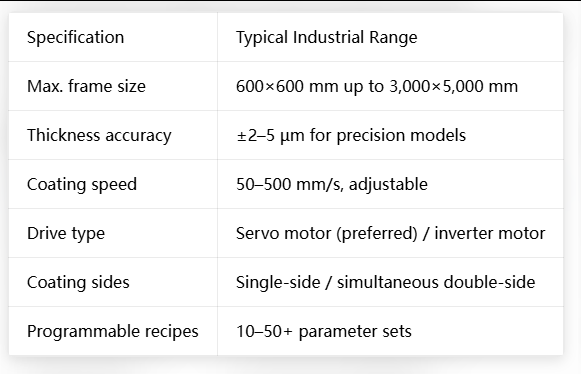
Key Specifications to Evaluate
How to Select the Right Machine
Match volume to automation level: Low-volume prototyping works with manual/semi-automatic; high-precision electronics production requires full automatic servo systems.
Size for your largest frame: Choose max coating area that covers your standard work with room for growth.
Prioritize labor-saving features: Recipe memory, quick clamps and double-sided coating directly reduce per-unit labor time.
Check material compatibility: Wetted parts should be corrosion-resistant (stainless steel / anodized aluminum).
Verify after-sales support: Ensure spare parts, training and maintenance documentation are readily available.
Operation & Maintenance Best Practices
Degas emulsion before use to prevent pinholes
Standardize recipes per mesh count for repeatable results
Operate in a clean, temperature-stable area to avoid dust defects
Clean troughs immediately after each use
Lubricate guide rails and calibrate pressure on schedule
Efficiency Optimization Tips
Batch screens by size and emulsion type to minimize changeovers
Use double-sided coating to cut cycle time in half
Position the coater adjacent to drying equipment to reduce wait time
Perform first-piece verification before running full batches
Frequently Asked Questions
What is the difference between emulsion coating machine and screen coater?
They are largely interchangeable. "Emulsion coating machine" is the broader technical term, while "screen coater" specifically refers to screen printing frame applications.
How thick should emulsion coating be?
Dried emulsion typically ranges from 8–25 µm above the mesh. Fine-detail printing uses thinner coatings; heavy ink deposits (textile, conductive pastes) require thicker stencils.
How long does an emulsion coating machine last?
With proper maintenance, industrial-grade machines last 10–15 years or more. Mechanical frames have the longest service life; seals, bearings and electronics are replaced periodically.
Is automatic emulsion coating worth the investment?
For operations coating 10+ screens daily, automatic coating pays for itself through labor savings, reduced rework and lower emulsion waste. For very low volumes, manual or semi-automatic options are more cost-effective.
Final Thoughts
An emulsion coating machine is the foundation of stencil quality and production consistency. By matching automation level to your output needs, focusing on core mechanical quality and following disciplined operating routines, you can reduce waste, improve resolution and scale production with confidence.
Previous: Screen Stretching Machine: Key Parameters, Selection & Maintenance Guide for Precision Printing Next: LED Energy Saving Screen Exposure Machine: A Practical Guide to Cost Savings & Precision Upgrade


