


News Center
The Ultimate Guide to Screen Stretching Machines: Boost Print Quality & Production Efficiency
 2026-06-03
 233
233
In screen printing, proper mesh tension is the foundation of every high-quality print. A reliable screen stretching machine ensures uniform tension, sharp details, and consistent results. Whether you run a small studio or industrial facility, the right equipment will reduce waste, increase productivity, and improve your bottom line.
What Is a Screen Stretching Machine?
A screen stretching machine (also called a mesh stretcher or screen tensioning machine) stretches and secures mesh material tightly onto screen printing frames. It works by clamping the mesh, applying controlled tension in both directions, positioning the frame, and bonding the mesh with adhesive. Modern machines achieve tension deviations of less than 0.5N/cm for exceptional precision.
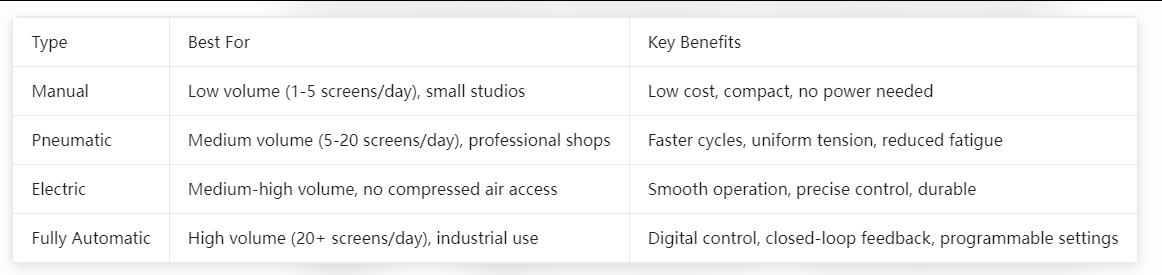
4 Main Types of Screen Stretching Machines
Why Invest in a Quality Screen Stretching Machine?
Superior print quality: Sharper edges, accurate registration, even ink density
Faster production: Reduced screen prep time, higher daily capacity
Longer screen life: Fewer replacements, lower material costs
Less waste: Minimized misprints and rework
Greater versatility: Handles various mesh types and frame sizes
How to Choose the Right Machine
Production volume: Match machine type to your daily output
Frame size: Ensure it accommodates your largest current and future frames
Tension requirements:
Textile printing: 15-25N/cm
Graphic printing: 20-30N/cm
Electronics/PCB: 25-35N/cm
High-precision industrial: 30-45N/cm
Build quality: Look for heavy-duty steel construction and durable components
Ease of use: Intuitive controls and simple maintenance procedures
Key Industry Applications
Textile and apparel printing
Graphic and sign manufacturing
Electronics and PCB production
Industrial product marking
Packaging and label printing
Professional Stretching Best Practices
Prepare a clean, level workspace
Use high-quality mesh and rigid aluminum frames
Load mesh evenly and clamp securely
Apply tension gradually, alternating sides
Verify uniformity with a tension meter (max 1-2N/cm difference)
Apply adhesive precisely and allow full curing
Release tension slowly to avoid damage
Essential Maintenance Schedule
Daily: Clean surfaces, remove residue, inspect for damage
Weekly: Lubricate moving parts, tighten fasteners, check clamps
Monthly: Test tension accuracy, inspect belts/chains, service pneumatics
Annual: Full inspection, replace worn parts, calibrate systems
Frequently Asked Questions
Q: What mesh materials work with these machines?
A: Most handle polyester, nylon, and stainless steel mesh from 20 to 500 threads per inch.
Q: How long do stretched screens last?
A: Properly stretched screens can last hundreds to thousands of prints. Regular re-stretching extends their lifespan.
Q: Is a tension meter necessary?
A: Yes. While experienced operators can estimate tension, a meter provides objective measurements for consistent quality.
Conclusion
A screen stretching machine is a critical investment for any screen printing business. It directly impacts print quality, production efficiency, and profitability. By selecting the right equipment for your needs and following proper operation and maintenance procedures, you can achieve consistent, professional results that keep your customers satisfied.
Need help finding the perfect screen stretching machine for your operation? Our experts can provide personalized recommendations based on your production volume and application requirements.
Previous: Eco-Friendly SMT Stencil Cleaning Machines: Boost Yields, Cut Costs & Meet Regulations Next: Subit Technology to Showcase Cutting-Edge Stencil & Scraper Inspection Solutions at EIM Vietnam 2026


