



News Center
The Ultimate Guide to SMT Squeegee Blade Cleaning Machine: Boost Efficiency & Cut Costs
 2026-04-28
 238
238
In Surface Mount Technology (SMT) manufacturing, solder paste printing is the most critical stage of PCB assembly—over 70% of SMT defects stem from inconsistent printing, and squeegee blade condition is the top influencing factor. A clean, undamaged squeegee ensures uniform paste deposition and precise print quality, making an SMT squeegee blade cleaning machine an essential tool for modern SMT facilities, from small workshops to high-volume production lines.
This guide simplifies the key essentials of SMT squeegee cleaning: why it matters, manual vs. automated cleaning, core benefits of dedicated machines, must-have features, and best practices to maximize your investment—tailored for SMT process engineers, production managers, and procurement teams focused on quality and efficiency.
Why Squeegee Blade Cleaning Is Critical for SMT Success
Squeegee blades are the workhorse of solder paste printing, applying consistent pressure to spread paste through stencil apertures onto PCBs. Even tiny residues, flux buildup, or particle contamination on the blade edge causes costly defects: solder bridging, insufficient paste deposition, solder balling, and premature stencil damage. Neglected cleaning also accelerates blade wear, increasing consumable costs and unplanned downtime.
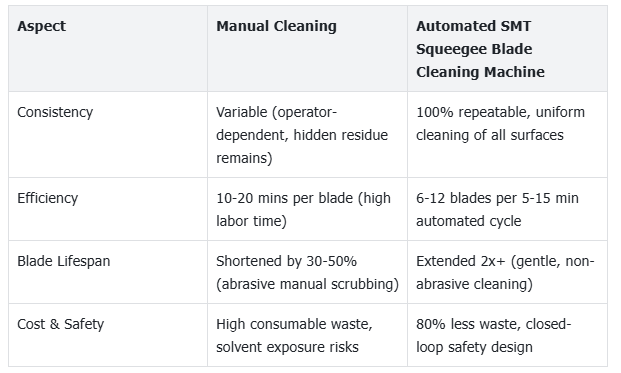
Manual cleaning fails to remove hidden residue in blade gaps and corners—only a dedicated SMT squeegee blade cleaning machine delivers the repeatable, thorough cleaning needed for zero-defect production.
Manual vs. Automated Squeegee Cleaning: Key Differences
Most SMT facilities still use manual cleaning (lint-free wipes + IPA), but it’s inefficient and inconsistent. Below is a concise comparison with automated systems:
Core Benefits of an SMT Squeegee Blade Cleaning Machine
- Improve Print Yield: Reduce rework by up to 60% by eliminating residue-related defects, critical for fine-pitch PCBs.
- Lower Consumable Costs: Extend squeegee lifespan 2x+, cutting annual blade replacement expenses.
- Save Labor Time: Fully automated cycles free operators for high-value tasks, reducing line downtime.
- Enhance Safety & Compliance: Closed-loop systems minimize solvent exposure and hazardous waste, meeting global safety standards.
- Standardize Processes: Programmable cycles ensure consistent cleaning, simplifying ISO 9001 compliance.
Must-Have Features to Prioritize
Not all cleaning machines are equal—focus on these non-negotiable features for optimal performance:
- Dual cleaning technology (ultrasonic + high-pressure spray) for thorough residue removal.
- Batch capacity (6-12 blades) and size flexibility (up to 600mm) for standard SMT lines.
- Fully automated operation with programmable PLC control and touchscreen HMI.
- Closed-loop filtration to reduce solvent waste and operating costs.
- SUS304 stainless steel construction for corrosion resistance and durability.
- Safety interlocks (door-open shutdown, emergency stop) for operator protection.
Best Practices for Maximum ROI
- Clean blades during stencil changes, shift handovers, and after 4+ hour runs.
- Load blades securely (per manufacturer guidelines) to avoid uneven cleaning or damage.
- Use custom cleaning programs for fresh vs. dried residue.
- Perform weekly maintenance (filter checks, nozzle cleaning) to minimize downtime.
- Inspect blades post-cleaning to validate results and prevent print defects.
Common Mistakes to Avoid
Steer clear of these pitfalls to protect your blades and print quality:
- Using harsh, unapproved solvents that damage blades or machine components.
- Skipping cleaning cycles (allows dried paste to harden and damage blades).
- Manual scrubbing post-automated cleaning (causes edge deformation).
- Overlooking hidden residue in blade gaps and corners.
Conclusion
A dedicated SMT squeegee blade cleaning machine transforms SMT operations by solving the inefficiencies of manual cleaning. It boosts print quality, extends blade life, cuts costs, and enhances safety—making it a strategic investment for any facility aiming to stay competitive in high-precision SMT manufacturing. By prioritizing the right features and following best practices, you’ll turn squeegee maintenance from a pain point into a competitive advantage.
Previous: Screen Printing Exposure Machine: The Essential Guide for Print Precision & Efficiency Next: Full Auto Stencil Printing Squeegee Blade Inspection Machine: Elevate SMT Quality & Efficiency


