


News Center
Master Screen Exposure: Choose the Right UV Screen Exposure Machine for Precision & Efficiency
 2026-04-11
 571
571
Elevate your screen printing and PCB manufacturing with a high-performance screen exposure machine—the cornerstone of precise pattern transfer. Whether you’re producing custom textiles, industrial labels, or high-precision circuit boards, selecting the right exposure unit ensures sharp, consistent results, reduces waste, and streamlines your workflow.
Core Keywords & Semantic Expansion
Primary Term: Screen exposure machine, screen exposure unit, screen exposing machine
Related Terms: UV screen exposure machine, UV LED exposure machine, vacuum exposure machine, PCB exposure machine, screen printing exposure unit, industrial exposure machine
Application Terms: Screen exposure machine for PCB, screen exposure machine for textile printing, screen exposure machine for packaging, high-precision screen exposure machine
Feature Terms: Automatic screen exposure machine, vacuum contact screen exposure machine, LED screen exposure machine, double-sided screen exposure machine, screen exposure machine with CCD alignment
Technical Terms: UV exposure wavelength, screen exposure vacuum system, screen exposure light source, screen exposure uniformity, screen exposure resolution
What Is a Screen Exposure Machine?
A screen exposure machine is a precision device that uses ultraviolet (UV) light to transfer intricate patterns from a film positive (or digital mask) onto a screen coated with light-sensitive emulsion or a PCB substrate coated with photoresist. Through photochemical reaction, the exposed areas harden permanently, while unexposed areas are washed away, creating a durable stencil for printing or circuit patterning.
As the heart of screen printing and PCB production, it directly determines the sharpness of edges, accuracy of fine details, and consistency of mass production. A reliable exposure unit eliminates guesswork from manual exposure, ensuring every screen or circuit board meets your quality standards.
How Does a Screen Exposure Machine Work?
The process combines precision engineering and controlled light exposure, with key steps tailored to different applications:
Preparation: Coat the screen with emulsion (screen printing) or the PCB substrate with photoresist, then dry in a dark environment to prevent pre-exposure.
Alignment: Place the film positive (artwork) or digital mask onto the coated screen/substrate and secure it tightly. For precision work, use a vacuum system to eliminate gaps between the film and substrate, ensuring crisp pattern transfer.
Exposure: Activate the UV light source (UV LED, metal halide, or mercury lamp) for a pre-set time. The light hardens the emulsion/photoresist in exposed areas, forming the desired pattern.
Washout & Cure: Rinse the screen/substrate to remove unexposed emulsion/photoresist, then dry and cure to finalize the stencil or circuit pattern.
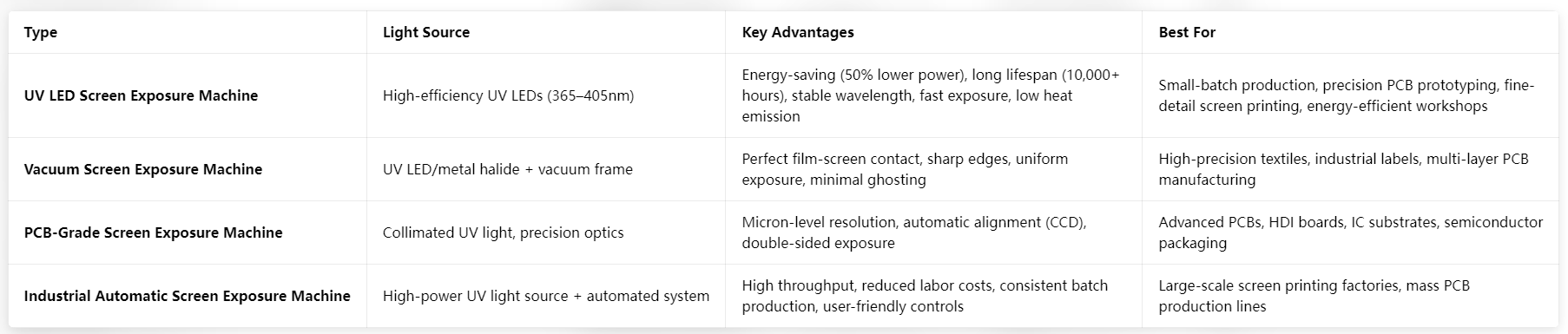
Key Types of Screen Exposure Machines
Choose the right model based on your production needs, precision requirements, and budget:
Critical Features to Prioritize
When selecting a screen exposure machine, focus on these performance-driving factors to maximize efficiency and quality:
Vacuum System: A reliable oil-less vacuum pump ensures tight contact between the film and substrate, critical for fine details. Look for uniform vacuum pressure and fast inflation/deflation speeds.
Light Source & Uniformity: Choose a machine with high UV intensity and uniform light distribution (±5% variation) to avoid over/underexposure. LED sources offer consistent wavelength, while metal halide lamps provide broad-spectrum coverage for thick emulsions.
Precision Control: Digital timers, adjustable exposure power, and (for PCB work) CCD alignment systems ensure repeatable results. For large formats, select models with adjustable working sizes to accommodate diverse screen/PCB dimensions.
Durability & Safety: CE certification, heat dissipation systems (to prevent component damage), and safety interlocks ensure long-term reliability and operator protection. Low-maintenance designs (e.g., sealed LED modules) reduce downtime.
Compatibility: Ensure the machine supports common emulsions (water-based/ solvent-based) and photoresists, as well as various screen mesh counts and PCB substrate sizes.
Applications Across Industries
A high-quality screen exposure machine is versatile, supporting diverse production needs:
Screen Printing: Custom textiles (t-shirts, sportswear), promotional products (bags, stickers), industrial labels, packaging boxes, and signage.
PCB & Electronics Manufacturing: Single-sided/multi-layer PCBs, flexible circuits, solder mask exposure, and semiconductor component patterning.
Specialized Industries: Medical device printing, automotive parts labeling, ceramic tile printing, and LCD panel manufacturing (high-precision versions).
Why Invest in a Premium Screen Exposure Machine?
Cost Savings: Reduced waste from misaligned or low-quality screens, lower energy consumption (LED models), and faster production cycles cut operational costs significantly.
Quality Consistency: Eliminates human error from manual exposure, ensuring every batch meets strict quality standards—critical for repeat clients and high-precision work.
Scalability: Automatic and high-throughput models grow with your business, supporting small batches to mass production without compromising quality.
Long-Term Value: Durable components and low maintenance extend the machine’s lifespan, delivering a strong return on investment for both small workshops and large factories.
How to Select the Perfect Screen Exposure Machine for Your Business
Define Your Needs: Specify your production volume (small/batch/mass), working size requirements, and precision goals (e.g., fine details vs. standard labels).
Match Light Source: Prioritize LED for energy efficiency and precision; metal halide for high-intensity, broad-spectrum exposure (thick emulsions).
Evaluate Features: Ensure the machine has a robust vacuum system, precise controls, and safety certifications. For PCB work, add CCD alignment and double-sided exposure capabilities.
Consider Future Growth: Choose a scalable model that can adapt to new applications (e.g., moving from screen printing to PCB prototyping) or larger production runs.
Final Thoughts
A screen exposure machine is more than just a production tool—it’s an investment in the quality, efficiency, and scalability of your business. Whether you’re a small screen printing shop or a large PCB manufacturer, selecting the right UV screen exposure machine will elevate your pattern transfer process, reduce costs, and help you stand out in competitive markets.
At SUBIT, we engineer screen exposure machines tailored to global industry standards, combining precision engineering, energy efficiency, and user-friendly design to meet the diverse needs of our international clients. Contact us today to find the perfect exposure unit for your workflow.
Previous: SUBIT Attends Dongguan Electronics Industry Association Annual Conference Next: Screen Printing Equipment Manufacturers | SUBIT Technology’s 10+ Years of Expertise


