



News Center
SMT First Detector: The Guide to First Article Inspection (FAI) in Electronics Manufacturing
 2026-04-02
 388
388
In the fast-paced world of electronics manufacturing, where precision and efficiency are non-negotiable, the SMT First Detector (also known as First Article Inspection System or FAI machine) has emerged as a critical quality control tool. This advanced technology serves as the first line of defense against costly production errors, ensuring that Surface Mount Technology (SMT) assembly processes meet rigorous industry standards before full-scale manufacturing begins. As electronic devices become increasingly complex with smaller components and tighter tolerances, the role of the SMT First Detector in preventing batch defects and maintaining compliance with regulations like AS9102 and ISO 9001 has never been more vital.
What is an SMT First Detector?
An SMT First Detector is a specialized inspection system designed to perform comprehensive verification of the first production unit (or small batch) after the SMT assembly process. Unlike Automatic Optical Inspection (AOI) or Solder Paste Inspection (SPI) which focus on specific process stages, the SMT First Detector conducts a holistic examination of the complete Printed Circuit Board Assembly (PCBA) before it proceeds through the reflow oven. This pre-production inspection verifies that all components match the Bill of Materials (BOM), are placed accurately according to Computer-Aided Design (CAD) coordinates, and meet specified electrical and mechanical requirements.
The primary distinction between a traditional manual first article check and an automated SMT First Detector lies in its ability to eliminate human error, increase inspection speed by 3-5 times, and provide comprehensive data traceability. Modern systems integrate intelligent software that automatically cross-references BOM data with physical component measurements, generating detailed First Article Inspection Reports (FAIR) for process validation and quality documentation.
How Does an SMT First Detector Work?
The operational workflow of an SMT First Detector typically follows these key steps:
Data Integration: The system imports critical manufacturing data including BOM, CAD coordinates, and component specifications.
PCBA Scanning: High-resolution cameras capture detailed images of the first article PCBA, creating a digital map of component placements.
Component Verification: Using advanced algorithms and flying probe testing technology, the system measures Inductance, Capacitance, and Resistance (LCR) values of each component, ensuring they match design specifications.
Placement Validation: The detector checks component orientation, position accuracy (often within ±50μm tolerance), and absence of missing, reversed, or duplicated parts.
Automated Reporting: Real-time PASS/FAIL results are generated, along with comprehensive documentation including component images, measurement data, and deviation analysis.
This automated process not only accelerates changeover between production runs but also provides manufacturing teams with actionable insights to correct process issues before they escalate to mass production.
Key Benefits of Implementing an SMT First Detector
Investing in an SMT First Detector delivers measurable advantages across production efficiency, quality control, and cost management:
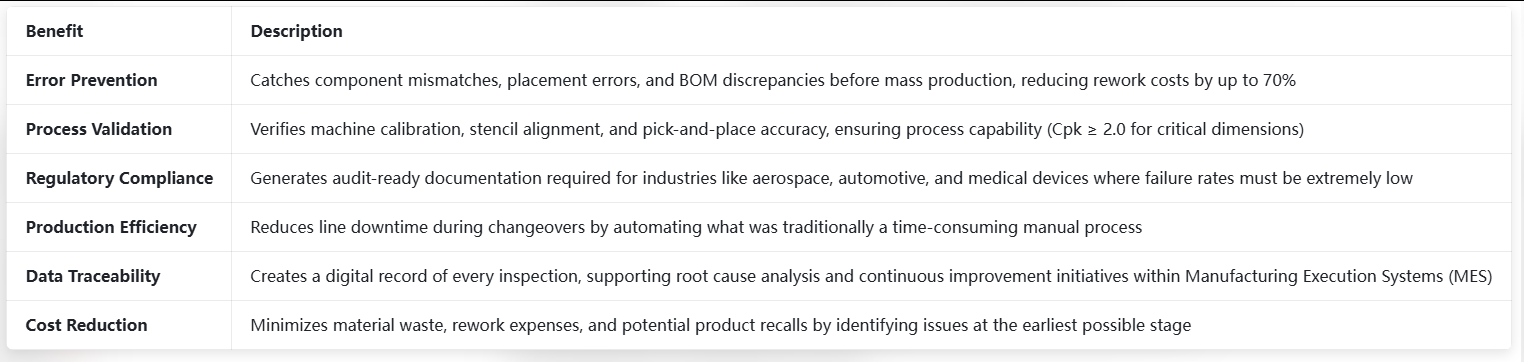
Critical Applications and Industry Use Cases
SMT First Detectors are indispensable in manufacturing environments characterized by:
High-Mix, Low-Volume Production: Where frequent product changes increase the risk of setup errors
Miniaturized Components: Including 0201 chips and microBGAs where visual inspection is unreliable
High-Reliability Industries: Such as aerospace, defense, and medical devices where component verification is mission-critical
New Product Introductions (NPI): Where process validation is essential before full-scale production
Regulated Sectors: Requiring comprehensive documentation for compliance audits
In automotive electronics manufacturing, for example, SMT First Detectors ensure that safety-critical components like ADAS system PCBs meet exact specifications, while in the medical device industry, they help maintain compliance with FDA regulations for electronic implants.
How to Choose the Right SMT First Detector
Selecting an appropriate SMT First Detector requires evaluating several key factors:
Inspection Capability: Ensure the system supports the component types (passive, active, connectors) and package sizes used in your production
Data Integration: Verify compatibility with your existing BOM, CAD, and MES systems for seamless workflow integration
Measurement Accuracy: Look for systems with high-precision flying probes capable of measuring LCR values within tight tolerances
Programming Flexibility: Choose solutions with intuitive software that reduces setup time for new product configurations
Reporting Features: Evaluate the system's ability to generate customizable FAIR documents compliant with industry standards
Scalability: Consider future production needs, including potential increases in board size, component density, and production volume
Modern SMT First Detectors often include AI-powered features that automatically identify wrong/repeated BOM consumption, multiple pieces, small components, and polarity issues, further enhancing inspection accuracy and efficiency.
Best Practices for Implementing SMT First Detection
Maximize the effectiveness of your SMT First Detector with these implementation strategies:
Standardize Inspection Protocols: Establish clear guidelines for when first article inspection is required (new products, material changes, equipment adjustments, or process modifications)
Integrate with Quality Management Systems: Connect the SMT First Detector with your QMS to automate non-conformance reporting and corrective action workflows
Train Operators Thoroughly: Ensure staff understand both the technical operation of the equipment and the interpretation of inspection results
Establish Thresholds for Action: Define clear criteria for when production should pause based on inspection findings, balancing efficiency with quality assurance
Leverage Data Analytics: Use the wealth of inspection data to identify recurring issues and drive process improvements across your SMT lines
The Future of SMT First Detection Technology
As electronics manufacturing continues to evolve, SMT First Detector technology is advancing with features like:
AI-Driven Predictive Analytics: Machine learning algorithms that identify potential process issues before they cause defects
Real-Time Process Adjustment: Systems that automatically communicate with SMT placement machines to correct minor deviations
3D Imaging Capabilities: Enhanced visualization for inspecting complex components and hidden solder joints
Cloud-Based Data Management: Centralized storage and analysis of inspection data across multiple manufacturing facilities
These innovations will further strengthen the role of SMT First Detectors as indispensable tools for smart factories and Industry 4.0 initiatives, ensuring that quality control keeps pace with the increasing complexity of electronic devices.
Conclusion
The SMT First Detector has evolved from a specialized tool to a fundamental requirement for modern electronics manufacturing operations. By implementing this technology, manufacturers can significantly reduce production risks, improve process efficiency, and maintain compliance with stringent industry standards. As component miniaturization and production complexity continue to accelerate, investing in a high-quality SMT First Detector is not just a competitive advantage but a necessity for businesses aiming to deliver reliable products while minimizing costs and maximizing customer satisfaction.
Whether you're producing consumer electronics, automotive components, or medical devices, the SMT First Detector serves as your quality assurance gatekeeper, ensuring that every production run starts on the right track and stays there throughout the manufacturing process.
Would you like me to adjust the article length to hit a specific character count, or optimize it further for a particular keyword density?
Previous: SUBIT: Premier SMT Squeegee Inspection Machine Manufacturer in Shenzhen Next: Semi-Automatic Detector: The Ultimate Guide for Industrial Quality Control & Precision Inspection


